Millions of people now talk to software every day: for advice, practice, comfort, and company. Here's a plain-English, data-backed look at what AI companions actually are, what they're good for, where they fall short, and how to pick one wisely.
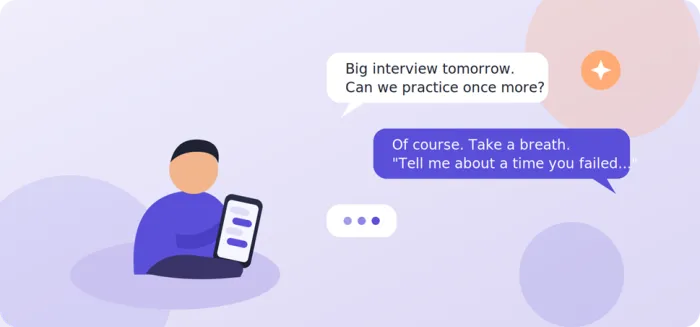
ILLUSTRATION — The core experience: an always-available conversation partner that remembers context. (Original artwork)
What exactly is an AI companion?
An AI companion is a software application, usually powered by a large language model, designed for ongoing, personalized, two-way conversation. Unlike a search engine (which answers a query and forgets you) or a task assistant (which sets your timer and moves on), a companion is built around continuity: it remembers preferences, adapts its tone to you, and is available whenever you open the app.
Three ingredients separate a true companion from an ordinary chatbot:
• Memory and context. It recalls past conversations, your goals, and your preferences, so each session builds on the last.
• Personality and emotional register. It's tuned to converse naturally (encouraging, humorous, calm) rather than to output facts.
• Relationship framing. The product is designed for repeated, open-ended interaction: a coach, tutor, brainstorming partner, or friendly presence.
Under the hood, these apps combine natural-language processing, sentiment analysis, and increasingly voice and vision, which is why the category now spans everything from text chat apps to talking wearables and companion robots.
The three main types of AI companion
Industry analysts group the market into three formats. Text-based companions remain the largest slice, about 42.7% of 2025 revenue per Grand View Research, because they run on any phone and are easy to use anywhere.
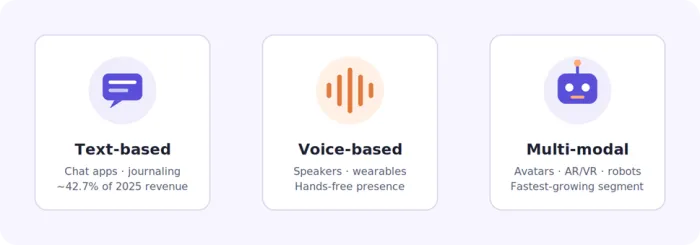
ILLUSTRATION — The three formats: text chat, voice, and multi-modal companions. (Original artwork)
Types of AI companions at a glance
2025 revenue share estimates from Grand View Research
| TYPE | HOW YOU INTERACT | BEST FOR | 2025 SHARE |
|---|---|---|---|
| Text-based (largest segment) | Chat interface, like messaging a friend | Journaling, advice, practice conversations, discreet use anywhere | ~42.7% |
| Voice-based | Spoken conversation via phone, speaker, or wearable | Hands-free use, accessibility, older adults, feeling of "presence" | Mid-size |
| Multi-modal (fastest growing) | Text + voice + avatars, AR/VR, or robots | Immersive experiences, education, elder-care robotics | Smallest, fastest CAGR |
Popular AI companion tools: a few examples
To make this concrete, here are some of the best-known tools in each category. This is not a ranking or an endorsement; pricing and features change often, so verify before subscribing.
Example AI companion tools by use case
Feature and pricing details as commonly reported; check each app before signing up
| TOOL | TYPE | BEST KNOWN FOR | PRICING MODEL |
|---|---|---|---|
| Replika | Text + voice avatar | One of the earliest personal companions; a customizable avatar that builds a long-term "relationship" with you | Freemium, Pro subscription |
| Character.AI | Text | Millions of user-created characters for roleplay, fandom, and entertainment; the engagement leader at ~92 min/day | Free, paid c.ai+ tier |
| Pi (Inflection AI) | Voice + text | A calm, emotionally intelligent everyday conversationalist; strong natural voice | Free |
| Wysa | Text | Mental-wellness companion built around CBT exercises; also used by employers and health services | Freemium, premium coaching |
| Talkie | Text + voice | Character-based chat and interactive stories, popular with younger users | Freemium, in-app purchases |
| Nomi | Text + images | Companions with strong long-term memory that recall details across months of conversation | Freemium, subscription |
| ElliQ | Voice robot | A tabletop companion robot for older adults: check-ins, reminders, and conversation | Hardware + subscription |
A quick way to map these to your goal: Wysa if wellness is the priority, Pi for a free everyday sounding board, Character.AI or Talkie for entertainment, Replika or Nomi for a persistent one-to-one companion, and ElliQ for an older relative living alone. General assistants such as ChatGPT, Claude, and Gemini can also play a companion-like role, though they are built as generalists rather than relationship-first apps.
How big is this, really? The data
Very big, and compounding fast. Precedence Research values the global AI companion market at $37.1 billion in 2025, projecting it to reach roughly $552 billion by 2035 at a 31% compound annual growth rate. Grand View Research lands in the same neighborhood: $36.8 billion in 2025, heading toward $318 billion by 2033. (Narrower definitions that count only consumer "companion apps" produce smaller figures, a reminder to always check what a market number includes.)
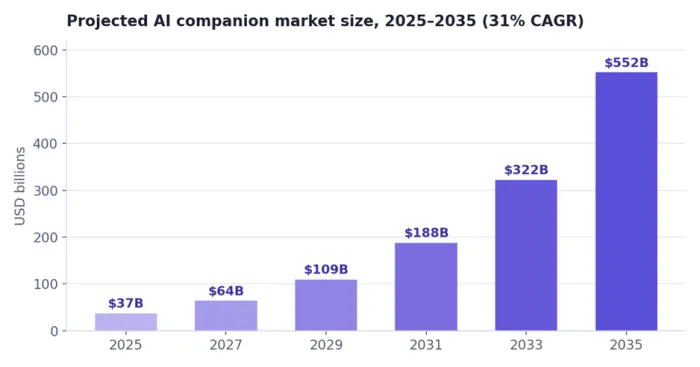
FIG. 1 — Interim years interpolated at the reported 31% CAGR from the 2025 base of $37.1B. Source: Precedence Research, "AI Companion Market," Dec 2025.
Adoption is broadening just as quickly as revenue:
16 → 128 Dedicated AI companion apps released per year grew eightfold between 2022 and mid-2025, a sign that this has moved from novelty to a full product category. Source: ElectroIQ AI Companions Statistics, 2025 |
72% of U.S. teens have tried an AI companion at least once, according to 2025 survey research, while 80% still report spending more time with human friends than with chatbots. Source: 2025 survey data reported via ElectroIQ / TechCrunch |
North America led with about a third of global revenue in 2025, with Asia-Pacific expected to grow fastest through 2035. That is relevant if you're in India, where localized, multilingual companions are a major growth frontier.
Why people actually use them
The stereotype is "lonely people talking to robot girlfriends." The data says the reality is more ordinary. In usage surveys, the top motivations are entertainment and curiosity, followed by advice-seeking, and a large share of regular users treat companions as a low-stakes mental-wellness outlet.
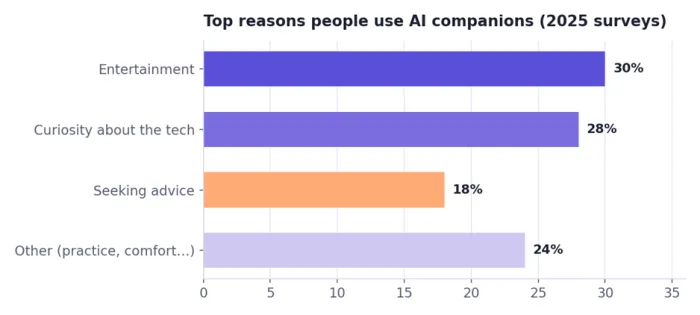
FIG. 2 — Primary-motivation shares from 2025 user surveys compiled by ElectroIQ. Separately, 48% of users report relying on companions for mental-health support and 36% for learning (multiple responses allowed).
Engagement depth is striking. On the leading platform, Character.AI, users averaged about 92 minutes per day in-app, longer than the average person spends on most social networks, and users aged 18–35 make up over 70% of engagement on the top companion apps.
Why you might need one: 6 practical benefits
"Need" is a strong word. Nobody needs an AI companion the way they need sleep. But there are six well-documented jobs these tools do better, cheaper, or more consistently than the alternatives.
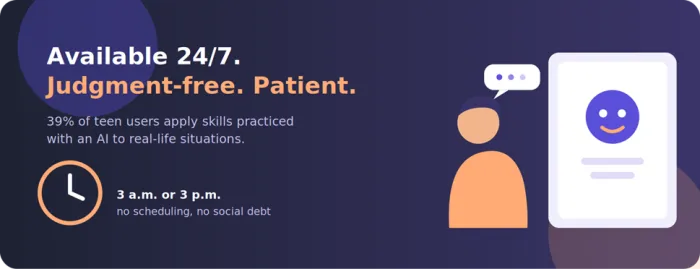
1. A 24/7 sounding board
Thoughts don't keep office hours. A companion is available at 3 a.m. before an exam, on a lunch break, or mid-commute, with no scheduling, no social debt, and no judgment.
2. Judgment-free practice
Rehearsing an interview, a salary negotiation, a difficult conversation, or a new language is far easier with a partner who never gets bored or laughs at you. Among teen users, 39% say they've applied skills practiced with an AI to real-life situations, most often conversation starters (18%), giving advice (14%), and expressing emotions (13%).
3. Low-barrier mental-wellness support
Stigma and cost keep many people from seeking help. Companions offer an anonymous first step: 48% of users report using them for mental-health support, and clinically-oriented apps like Wysa structure conversations around cognitive-behavioral techniques. This is support, not therapy, but for many people it's the difference between "talking to no one" and "talking to something."
4. Personalized learning
About 36% of users use companions for learning: language practice, explanations at your own pace, and quizzing that adapts to what you get wrong. Unlike a video course, a companion answers your follow-up questions.
5. Companionship for isolated groups
For older adults living alone, people with mobility constraints, or those in remote areas, voice companions and companion robots provide daily interaction, reminders, and a check-in presence, one reason healthcare is among the fastest-growing verticals in the market.
6. A thinking and productivity partner
Businesses are the fastest-growing segment of the market (~33% CAGR per Grand View Research) because the same conversational continuity that makes a good friend makes a good work aide: brainstorming, drafting, summarizing, and remembering the thread of a project.
Benefit vs. best alternative: where a companion wins, and where it doesn't
| JOB TO BE DONE | AI COMPANION | HUMAN ALTERNATIVE | VERDICT |
|---|---|---|---|
| Venting at 3 a.m. | Instant, always on | Friends are asleep | Companion wins on availability |
| Interview practice | Unlimited, judgment-free reps | Limited patience, scheduling | Companion wins on repetition |
| Clinical mental-health care | Support only, not treatment | Licensed, accountable | Human professional wins |
| Deep friendship | Simulated reciprocity | Real mutual bond | Humans win, clearly |
| Language practice | Patient, adaptive, cheap | Tutors cost more per hour | Companion wins on cost |
| Accountability & habits | Consistent daily check-ins | Depends on the friend | Tie: use both |
The honest downsides
A trustworthy guide has to say this part plainly. AI companions come with four real risks:
• Emotional over-reliance. A companion that always agrees and is always available can crowd out harder, more nourishing human relationships, especially for heavy users and young people.
• Accuracy limits. Companions can state wrong things confidently. Users sense this: in 2025 surveys, 50% of teens said they don't trust information or advice from AI companions, 27% somewhat trust it, and only 23% fully trust it. That skepticism is healthy. Keep it.
• Privacy. You may share your most personal thoughts with these apps. Read the data policy: what's stored, whether conversations train models, and whether you can delete your history.
• Not a crisis tool. If you're in emotional distress or crisis, a companion is not the right resource. A professional, a trusted person, or a local helpline is.
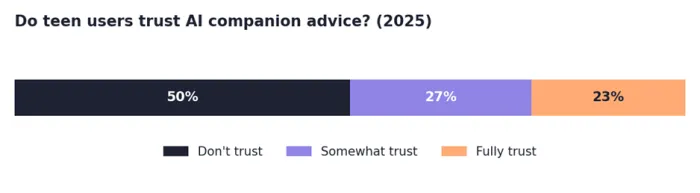
FIG. 3 — Source: 2025 teen-user survey data compiled by ElectroIQ. Healthy skepticism is the norm: treat companion advice as a starting point, not an authority.
How to choose an AI companion: a 7-point checklist
Personality is the fun part, but it's the last thing to evaluate. Vet the boring parts first:
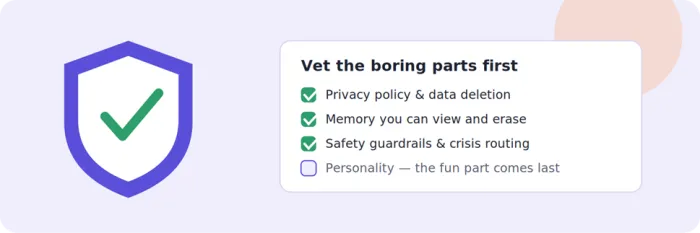
ILLUSTRATION — Vet privacy, memory, and safety before personality. (Original artwork)
Pre-download checklist
| # | CHECK | WHAT "GOOD" LOOKS LIKE |
|---|---|---|
| 1 | Privacy policy | Clear statement on data storage, training use, and one-tap conversation deletion |
| 2 | Memory controls | You can view, edit, and erase what it remembers about you |
| 3 | Safety guardrails | Crisis-detection routing to real resources; age-appropriate settings |
| 4 | Purpose fit | Wellness-focused (e.g., CBT-based), learning-focused, or general chat. Pick for your goal |
| 5 | Pricing honesty | Free tier is usable; no manipulative "your companion misses you" upsells |
| 6 | Modality | Text for discretion, voice for accessibility, multi-modal for immersion |
| 7 | Track record | Established developer, transparent about the model used, responsive support |
A healthy-use rule of thumb: a companion should be additive. If it's helping you practice for real conversations, learn faster, or feel steadier, it's doing its job. If you notice it replacing time with people you care about, that's your signal to rebalance. Reassuringly, most users do: 80% of teen users report spending more time with friends than with their AI.
The verdict
Worth trying, with clear boundaries
Weighing the evidence, AI companions make the most sense as a specific-purpose tool, not an all-purpose friend. The strongest case for them rests on three things: 24/7 availability, zero judgment, and near-zero cost compared to human alternatives like tutors, coaches, or therapists. For practicing a language, rehearsing tough conversations, or organizing your thoughts before bed, that combination is genuinely hard to beat.
The weaker case is the emotional one. A companion can simulate care convincingly, but it can't reciprocate it and the research on heavy, isolated usage is not reassuring. The risk isn't that the technology fails; it's that it works too well and quietly starts substituting for human contact instead of supplementing it.
Bottom line: If you have a defined use case learning, practice, reflection an AI companion is a low-cost experiment worth running, starting with a free tier. If what you're really looking for is connection, treat it as a bridge to more human interaction, never a destination.