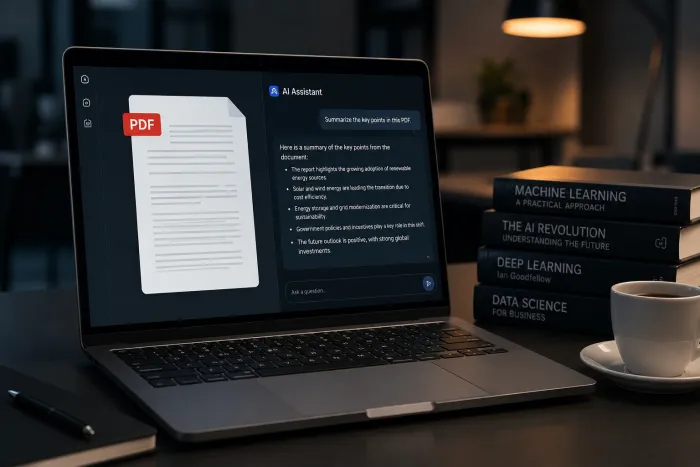
The year writing software stopped suggesting and started doing. Here is what actually changed across every tool that matters, from the models under the hood to the apps you type in.
If you last formed an opinion about AI writing tools in 2024, almost everything you knew is out of date. 2026 was not a year of new toys. It was a year of three deeper shifts that quietly rewired the whole category.
• Think, then write. The newest models plan structure first and can hold an entire book, report, or codebase in view at once, so long pieces stay coherent from the first page to the last.
• Assistants became agents. The word of the year was agent. Tools stopped only suggesting edits and started doing the work, drafting across files, running multi-step jobs, and finishing tasks while you do something else.
• The help came to you. The best assistance now lives inside the apps you already use, and the big platforms let you pick which AI engine is doing the writing.
PART 01
The engines under the hood
Every writing tool you touch is powered by a large language model. In 2026 those engines were upgraded at a genuinely dizzying pace, and the writing-relevant gains were as much about tone and reliability as raw intelligence.
OpenAI
A new GPT every few weeks
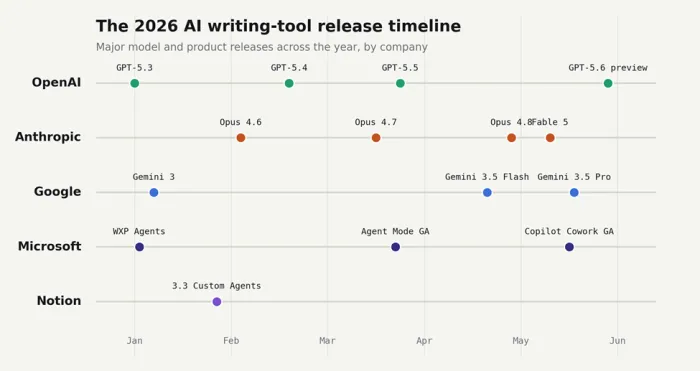
After GPT-5.2 closed out 2025, notable mostly for tightened cyber safeguards, 2026 brought a steady drumbeat: GPT-5.3, GPT-5.4, GPT-5.5 (released April 23, codenamed Spud), and a limited preview of the GPT-5.6 family on June 27. GPT-5.5 Instant quietly became the default for everyone in early May. For writers, the useful changes were the everyday ones. Version 5.3 deliberately cut filler and teaser phrasing, 5.4 can show its plan up front so you can redirect mid-draft, and writing now lives in dedicated blocks in the chat.
Anthropic Claude
The writer's pick gets faster and more honest
Claude kept its reputation as the model that produces the most natural prose and handles very long documents without losing the thread. The cadence ran Opus 4.5, then 4.6, then 4.7, then 4.8 on May 28, whose headline themes were reliability and honesty. It is roughly four times less likely than its predecessor to let its own mistakes slide. June brought a new Mythos-class tier sitting above Opus, led by Claude Fable 5.
Google Gemini
The Flash model that ate the flagship
At Google I/O in May, Google released Gemini 3.5 Flash with a surprising claim: the fast, cheap Flash tier now rivals the previous flagship on many benchmarks, at a fraction of the cost. It became the default Gemini across the app and Search. The 3.5 Pro flagship, with a context window up to 2 million tokens, followed in June, alongside Gemini Omni, a model built around native video.
2026 frontier models at a glance
| Lab | Flagship models | Why writers care |
|---|---|---|
| OpenAI | GPT-5.5; 5.6 preview | Cleaner tone, plan-first drafting |
| Anthropic | Claude Opus 4.8; Fable 5 | Most natural prose, honesty gains |
| Gemini 3.5 Flash and Pro; Omni | Cheap, fast, long context; in Workspace | |
| Meta | Llama 4 | Open weights for self-hosting |
The pattern across all of them is the same: fewer brand-new products, and much more dramatic upgrades to the existing leaders. The market is consolidating around a handful of frontier engines.
PART 02
The help moved into your apps
The single biggest practical change of 2026 is that you increasingly do not need a separate AI writing tool at all. The assistance is now baked into the document, the inbox, and the workspace.
Google Workspace
Gemini becomes your writing partner

In March, Google rebuilt how Gemini works in Docs. Help me create generates a fully formatted first draft from your own emails and files. Help me write refines specific sections with edits that stay private until you approve them. Match writing style unifies the voice across a document, so a piece touched by five people still sounds like one. Crucially, Gemini is now included in paid Workspace plans rather than sold as an add-on.
Microsoft 365 Copilot
Agents in Word, and a multi-model surprise
On April 22, Microsoft brought Agent Mode to general availability inside Word, Excel, and PowerPoint. Copilot now performs multi-step actions inside your actual documents, not just a side chat. Copilot Cowork, its long-running agentic mode, reached general availability on June 16, and Microsoft previewed Scout, its first always-on autopilot agent.
The bigger storyline is that Microsoft turned Copilot into a multi-model platform by adding Anthropic Claude alongside OpenAI models across Copilot Chat, Researcher, and the Word, Excel, and PowerPoint agents. In the commercial cloud, Claude even became the default engine in Excel and PowerPoint in early May, with Word following over the summer. One note for UK and EU readers: Anthropic models are off by default there for data-residency reasons and require an admin to opt in.
Notion
From AI that suggests to AI that does the work
Notion's agent push matured fast. Notion 3.3, released February 24, launched Custom Agents, autonomous teammates that run around the clock to draft status reports, triage requests, and answer recurring questions. The agent can work for up to 20 minutes across hundreds of pages, and because Notion is multi-model, a single subscription gets you GPT, Claude, and Gemini built in.
PART 03
The dedicated assistants
The standalone writing tools did not stand still. Several of the most familiar names reinvented themselves entirely.
Grammarly
It is now Superhuman

The most jarring rebrand of the year: Grammarly changed its company name to Superhuman, uniting its acquisitions, the workspace tool Coda and the email client Superhuman, under one banner. The Grammarly product still exists as the writing assistant, but the company now sells a suite plus Superhuman Go, a proactive agent that watches your screen across more than a million apps and offers help without being asked. It also shipped Grammarly Authorship, which attributes which parts of a document were written by a human versus an agent.
Jasper
It became a marketing operating system

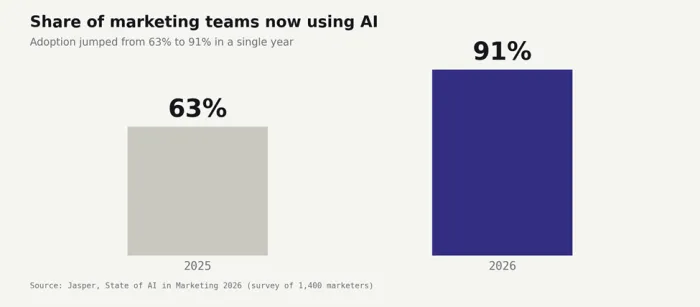
Jasper completed its shift from a simple AI copywriter into an enterprise marketing hub, shipping new features monthly. The flagship addition was the Optimization Agent in January, which optimizes content not just for traditional SEO but for GEO, getting your content cited inside AI answers. Jasper's own State of AI in Marketing 2026 report captured the mood: 91 percent of marketing teams now use AI, up from 63 percent a year earlier, but proving return on investment is the new hard part.
QuillBot
Rebranded into a creativity platform
The student and researcher favorite gave itself a full makeover in late May, with a new logo, a custom font, and a design-and-AI focus. On the practical side, it consolidated grammar checking, paraphrasing, translation, summarizing, and an in-page AI Cursor into a single Chrome extension, and pushed its tools onto iOS with a writing keyboard that supports chat and dictation.
Sudowrite
Stayed the novelist's pick

For fiction, Sudowrite held its spot as the category leader. Built around the novelist's workflow rather than business copy, it helps with brainstorming plot, describing scenes, expanding prose, and rewriting in a chosen style, plus a Visualize feature that generates art for worldbuilding. Pricing starts around 19 dollars a month. As ever, the output is a starting point that needs your editing to truly sound like you.
Also worth a look: Lex for distraction-free collaborative writing, Wordtune and ProWritingAid for editing and style, Canva Magic Write for writing tied to design, and fiction tools like Novelcrafter and AuthorFlows.
PART 04
The trends underneath the updates
Step back from individual products and a few clear themes define the year.
• From assistants to agents. The defining shift. The same idea repeats everywhere: software that executes multi-step work on its own rather than waiting to be prompted line by line.
• Reasoning first, book-length context. Models now plan before drafting and can hold an entire manuscript in view, which is why long-form output got noticeably more coherent.
• Multi-model is the default. Microsoft added Claude to Copilot, Notion ships GPT, Claude, and Gemini together, and Jasper is deliberately model-agnostic. Which engine wrote your draft is now a setting.
• GEO joins SEO. As people search inside AI answer engines, the goal shifted from ranking on a results page to being the source an AI cites.
• Governance and disclosure. With AI in every text box, companies invested in brand-voice controls, authorship attribution, and clearer rules on disclosing AI assistance.
• The detector and humanizer arms race. Detectors kept updating, and humanizers kept promising to slip past them. No tool can honestly promise to win that game against a detector that updates monthly.
PART 05
What it means for writers
Cutting through the hype, the practical advice for 2026 is simpler than the release notes suggest. Treat the output as a draft. Fact-check every claim, especially names, numbers, and dates. Edit for voice so it sounds like you. And disclose AI assistance wherever it is required.
Which tool for which job
| Your work | Sensible 2026 pick |
|---|---|
| Everyday all-purpose drafting | ChatGPT or Gemini (strong free tiers) |
| Natural prose and long documents | Claude |
| Writing inside Docs or Office | Gemini in Workspace or Copilot |
| Scaling marketing content | Jasper |
| Long-form fiction | Sudowrite |
| Paraphrasing and studying | QuillBot |
| A proactive cross-app assistant | Grammarly (now in the Superhuman suite) |
And with multi-model platforms now common, it is worth a glance at your settings, both to match the right model to the task, and because in regulated or enterprise work, the model behind your draft has compliance implications.
LOOKING AHEAD
What to watch in late 2026

• Frontier models going wider. Anthropic's Mythos tier and OpenAI's GPT-5.6 family are still rolling out under tighter access gates. Broader availability will reset the quality bar again.
• Agents getting more autonomous. Always-on autopilot agents like Microsoft Scout point toward software that runs your routine writing work in the background.
• GEO maturing. As AI answer engines become the front door to information, optimizing to be the answer keeps moving from niche tactic to default practice.
The tools are more powerful than ever, but the job underneath them has not changed. Original ideas, good judgment, an ear for voice, and the willingness to edit are still what separate writing people want to read from text a machine merely produced. In 2026, the craft is ancient and the tools are brand new.