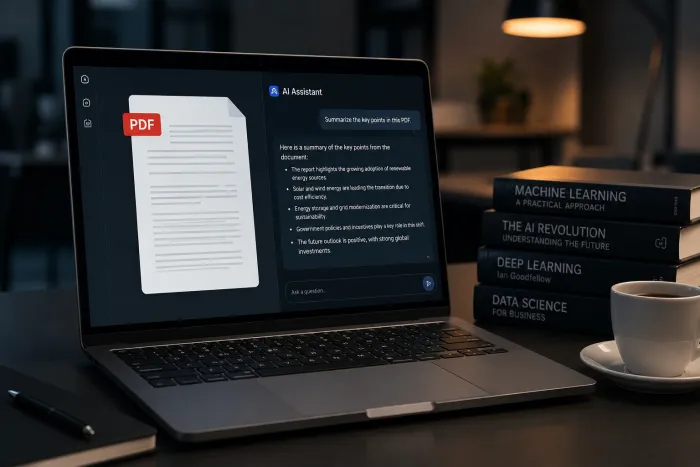
You do not have a productivity problem. You have a tab problem. Here is the hidden math behind the chaos, and the case for collapsing your AI stack into one.
You know the loop. You open a document to write, then a message pulls you into a thread, then you tab to email, to a browser, to one AI app to draft a paragraph, another to make an image, a third to fix code. Twenty minutes later you are back at the document, trying to remember what you meant to say.
It feels like work, but most of that motion produced nothing. It was the cost of moving between tools, and that cost runs higher than most people think. The argument here is simple: the workday is drowning in fragmented tools, the newest layer is a pile of single-purpose AI apps, and for most people one capable AI toolkit beats ten specialized ones.
Busy is not the same as productive
Every toggle looks harmless on its own. Measured across a day, the bill is enormous. A 2022 Harvard Business Review study found the average worker toggles between apps and websites roughly 1,200 times a day, and the price shows up as both time and attention. Cornell and Qatalog put the cost of getting back into a workflow at about 9.5 minutes per switch, while researchers at the University of California, Irvine found it can take more than 23 minutes to fully refocus after a real interruption. Multiple analyses estimate that context switching eats up to 40 percent of productive time, and McKinsey finds knowledge workers lose nearly two hours a day just searching for information. You can be busy for eight hours and still produce only a few.
| What was measured | Finding | Source |
|---|---|---|
| App and website switches, per person, per day | ~1,200 | Harvard Business Review, 2022 |
| Time to fully refocus after an interruption | ~23 min | UC Irvine (Gloria Mark) |
| Time to resume a workflow after a tool switch | ~9.5 min | Cornell / Qatalog |
| Time on one screen before switching away | under 3 min | Microsoft |
| Productive time lost to context switching | up to 40% | Multiple studies |
| Time per day spent searching for information | ~2 hrs | McKinsey |
| Apps a person switches between daily | ~9 | Asana, Anatomy of Work |
Figures vary by study, company size, and method. Read them as one consistent trend, not fixed constants.
The sprawl was never a decision
Nobody designed this. Marketing signed up for a design tool, sales picked its own CRM, a team lead started a trial that quietly became essential. Each choice solved a local problem, and together they became sprawl. Depending on how you count, a typical organization now runs between roughly 100 and 300 applications, up from fewer than 20 a decade ago, and Asana finds the average person switches between about nine apps a day. Then there is the waste. Studies routinely find that around half of software licenses go unused within a month, while per-employee software spending runs into the thousands per year. The result is not only a focus problem. It is a budget problem, a security problem, and a cognitive-load problem at the same time.
Now it is happening with AI
The same pattern is repeating with AI. A writer found a drafting tool, a designer an image generator, a researcher a chat app, a developer a coding assistant. Then people started using AI for everything, and the stack fragmented again. Picture one task: a client presentation that needs reasoning for the analysis, prose for the narrative, and an image for the cover. That is three or four tabs, three or four histories that do not talk to each other, and the same context re-pasted into each. The bill stacks up too. The leading standalone assistants each cost about 20 dollars a month, so three of them plus a dedicated image or video tool can push past 100 dollars a month for access you only partly use. It is the same idle-licenses story in a shinier coat.
Tab-switching is the symptom. Fragmentation is the disease.
Why one AI toolkit wins
Consolidating onto one capable toolkit fixes this, and the gains compound. Context stays put, so you build on a conversation instead of restarting it. You learn one interface deeply instead of ten shallowly. One subscription replaces a stack of half-used ones. Your data lives in fewer places, which is easier to secure. And a single tool can carry your history, prompts, and workflows as an asset that grows over time. None of these is dramatic on its own. Together they are the difference between producing and managing the tools you produce with.
| Dimension | Ten separate apps | One AI toolkit |
|---|---|---|
| Context | Re-explained at every switch | Held across the whole task |
| Learning curve | Ten interfaces, shallow | One interface, deep |
| Cost | Roughly $100+ a month | One subscription |
| Data and security | Scattered across accounts | Fewer places to guard |
| Memory and history | Siloed per app | One growing record |
| Output | Copy-paste between tools | Made in one place |
What one toolkit should actually include
Consolidation only pays off if the one tool is genuinely capable. Look for strong reasoning, native file handling, real structured output you can edit, built-in web search, visual generation, and persistent memory. A workspace missing too many of these just becomes another tab.
Three toolkits that qualify, and how to choose
Three assistants now fit most of that description, and each suits a different kind of work. All three cost about 20 dollars a month for their consumer tier, and all three include a frontier model, web search, file uploads, voice, and memory. The differences show up in daily use.
ChatGPT Plus (OpenAI). The broadest of the three. It bundles native image generation, a strong voice mode, custom GPTs, and the widest ecosystem of plugins and connectors. No single feature is best in class, but the sum is hard to beat. Best for people who want one app that does the most, including images and voice.

Claude Pro (Anthropic). The pick for people whose work is the writing or the thinking. It is strong on long documents, careful reasoning, and coding, with Projects for sustained work on one body of material and a large context window. The main tradeoff is that it does not generate images natively, though it can analyze ones you upload. Best for writing, research, analysis, and code where output quality matters most.
Google AI Pro, formerly Gemini Advanced (Google). The natural choice if your day already runs on Google. It lives inside Gmail, Docs, Sheets, Slides, and Chrome, so it reads and edits your files in place with no copy-paste, and it adds native image and video generation plus generous storage. Best for people embedded in Google Workspace.

A quick decision: pick the one whose surrounding tools you already use. Live in Google, choose Google AI Pro. Write or think for a living and want the cleanest output, choose Claude Pro. Want the most in one app, choose ChatGPT Plus. Two related routes are worth knowing: Perplexity if your main need is cited research, and multi-model aggregators such as Poe or TypingMind if you specifically want several models behind one login.
| Attribute | ChatGPT Plus | Claude Pro | Google AI Pro |
|---|---|---|---|
| Maker | OpenAI | Anthropic | |
| Price (individual) | ~$20 / month | ~$20 / month | ~$20 / month |
| Native image generation | Yes | No | Yes |
| Web search | Yes | Yes | Yes |
| Strongest at | Breadth, images, voice | Writing, reasoning, long docs, code | Google Workspace integration |
| Best for | One app that does the most | Writing and thinking work | People who live in Google apps |
| Watch-out | No single feature is best in class | No native image generation | Value is tied to Google use |
Representative individual-plan details for 2026. Capabilities and prices shift often, so confirm the current feature page before you commit.
One tool is not always the answer
The test: does this app do something your main toolkit genuinely cannot, and do you use it often enough to justify the extra switch and the extra bill? If yes, keep it. If it overlaps heavily or sits idle most weeks, it is sprawl.
It would be dishonest to pretend one tool always wins. A dedicated design tool for a designer, or a purpose-built analytics platform for a data team, can be worth keeping. The goal is not to own the fewest tools possible. It is to make sure every tool in your stack earns its place. Consolidation is about cutting the redundant, not the valuable and distinct.
How to make the switch
You do not need a dramatic overhaul. A gradual, deliberate cleanup works better and lasts longer.
1. Audit what you use. List every app and AI subscription you touch in a week, and how often you truly open it. Most people are surprised by how much is redundant.
2. Pick an anchor. Choose one capable AI toolkit as the default you reach for first.
3. Migrate one workflow at a time. Move your most common task first and run it there for a week before touching the next.
4. Cut the overlap. Cancel the single-purpose apps the anchor now replaces, watching for contract lock-ins.
5. Set a guardrail. Before adding any new tool, ask whether your toolkit already does the job.
Close the ten tabs
Every tool you ever adopted promised to make you faster, and most did. The failure was collective: a stack that grew until managing it became the job. Tab-switching is the symptom, and fragmentation is the disease. The cure is not another app to organize your apps. It is collapsing the sprawl into something coherent, ideally onto a single strong toolkit that handles the writing, the research, the images, the code, and the files in one place while holding your context as you go.
Stop paying the toggle tax. Close the ten tabs. Keep the one that does the work.