
You hit publish on a post you spent two days writing. A week later you open Search Console and find it parked on the third page for a phrase you barely targeted. Anyone who runs a site knows that feeling. The writing is rarely the hard part. The grind is the keyword research, the competitor digging, the on-page checklist, and the long wait to see if any of it moved the needle. That middle stretch is exactly where a tool like RedeepSeek is supposed to help.
This guide skips the sales language and walks through how the tool fits into real SEO work. Read it top to bottom, or jump to the section you need right now.
What this tool is actually for
RedeepSeek is an AI assisted SEO platform. In plain terms, it takes the repetitive research and analysis that used to swallow an afternoon and hands you a starting point in minutes. It does not replace your judgment, and it should not write your pages for you and hit publish. What it does is clear the busywork so your attention goes to the decisions that move rankings.
The chart below shows roughly where a working week goes when this is all done by hand, and how much of that an AI assist can shave off. Your split will look different, but the shape tends to hold: research and optimization eat the most time, and they are also the parts a tool helps with most.
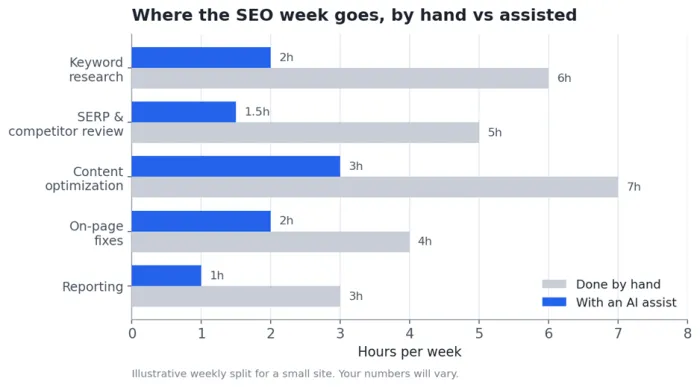
Manual SEO work against the assisted version, for a typical small site.
Step one
find keywords that earn their place
Most keyword lists are too long and too ambitious. People chase head terms with enormous volume and brutal competition, then wonder why a brand new page never shows up. The smarter move is to find phrases with enough demand to matter and little enough competition that your page has a real shot.
In RedeepSeek, start by feeding it a seed topic, something broad that describes what your page is about. It returns related queries with rough volume and difficulty attached. Skip the vanity terms sitting at the top. Look instead for the cluster in the lower left of the map below: steady searches, low difficulty. Those are the ones to build around first.
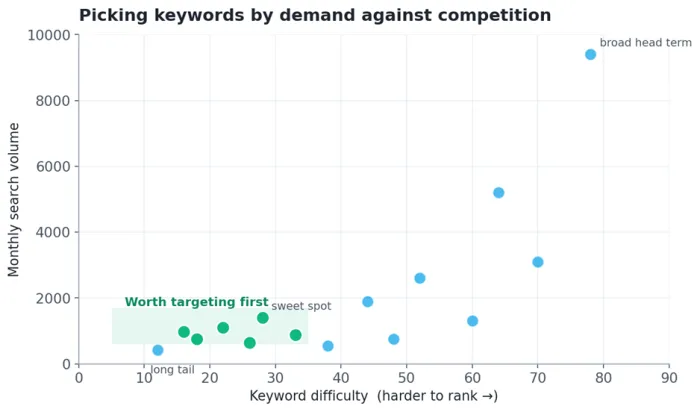
Plotting demand against competition. The shaded band is where a young site should start.
A few habits that pay off here:
• Sort by intent. Group queries by what the searcher wants, not just by the words. “Best running shoes” and “running shoes for flat feet” deserve different pages.
• Keep the questions. People phrase searches as questions, and those questions become your subheadings. They also tend to win featured snippets.
• Bank the hard ones. The borderline terms you cannot rank for today become next quarter's content once your site has earned more trust.
Step two
read page one before you write a line
Ranking is a comparison, not a solo performance. You are not writing into empty space, you are trying to be more useful than ten pages that already sit on the first page. So study them first.
Point RedeepSeek at your target keyword and let it pull the current top results. What you want is the pattern. How long are these pages on average. Which subtopics do all of them cover. What format keeps repeating, a list, a tutorial, a head to head comparison. And most useful of all, where are the gaps, the questions none of them answer well. That gap is your way in.
This takes about ten minutes and it changes everything about the draft that follows. Writing without it is just guessing in a nicer font.
Step three
turn the research into a draft worth publishing
Once you know what the page has to cover, RedeepSeek can help assemble a brief and a rough first draft. Use this part carefully. AI text that ships untouched reads like AI text, and both readers and search engines keep getting better at spotting it.
Treat the output as raw material, not a finished product. Keep the structure if it matches the intent you found. Then rewrite it in your own voice and add the things only you can: your data, your screenshots, your examples, your honest opinion. The draft gets you past the blank page. The rewrite is what makes the page yours, and what makes it rank.
A short checklist before you call a draft done:
• Does the opening answer the query in the first few lines, instead of burying it in paragraph ten?
• Did you cover the subtopics every top page shares, plus at least one thing none of them bothered to explain?
• Are the headings written the way people actually type their searches?
The on-page cleanup most writers skip
A genuinely good draft can still underperform because of small technical misses. This is the unglamorous part, and it is the part most writers walk right past.
Run the page through RedeepSeek's on-page check and work down the list it flags. Title tag length and clarity. A meta description that earns the click rather than describing the obvious. Headings in a sensible order. Image alt text. None of it is thrilling, but it is often the difference between a page that almost ranks and one that does.
Internal linking deserves its own mention because it is so easy and so neglected. A brand new page with nothing pointing to it is an island, and search engines treat it that way. Spend five minutes linking it to two or three related older posts, then add a link back from each of those posts to the new one. That small effort moves new pages faster than almost anything else on this list.
Step four
find out whether any of it worked
SEO runs on a long feedback loop, which is exactly why tracking and patience matter so much. Decide what you are measuring before you start: position for your target keyword, clicks and impressions in Search Console, and the slow climb of organic sessions over time.
Give a new page a few weeks before you judge it. The curve below shows the shape to expect from steady work, not from a single lucky post. Early on, almost nothing happens, and that flat stretch is where most people quit. Then, as pages pile up and a few start to rank, the line begins to bend. The sites that win are the ones that kept publishing through the boring part.
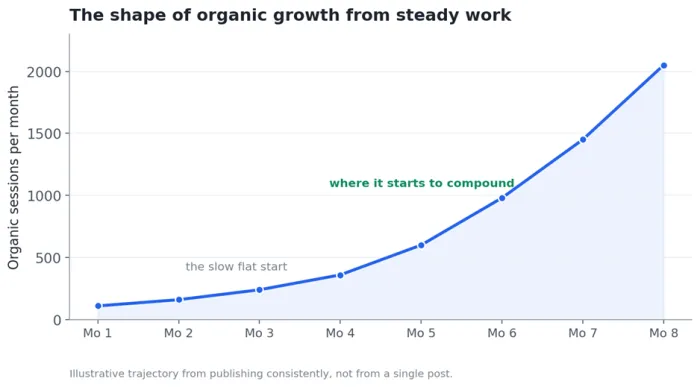
What consistent publishing tends to look like over the first several months.
A weekly rhythm you can actually keep
Tools only help if they fit a routine you can repeat without burning out. A workable week might look something like this, and none of it takes a whole day:
• Monday. Pull a fresh batch of keyword ideas and choose one or two to target.
• Tuesday and Wednesday. Study the SERP, draft, and rewrite the page in your own voice.
• Thursday. On-page cleanup and internal linking for what you just wrote.
• Friday. Check last month's pages, note what is climbing, and adjust the plan.
The whole point is consistency, not heroics. A small amount done every week beats a frantic burst once a quarter.
Where people trip up
A handful of mistakes show up again and again, no matter the niche:
• First, Shipping AI drafts unedited, then wondering why they sit flat for months.
• Second, Chasing high volume keywords a young site has no chance of winning yet.
• Third, Judging a page after one week instead of giving it a full quarter.
• Fourth, Polishing the writing while ignoring the title tags, links, and other basics.
• Fifth, Treating the tool as the whole strategy rather than the assistant that supports one.
Avoid those five and you are already ahead of most of the sites you are competing with.
The part worth remembering
The plain truth about SEO is that it rewards steady, slightly boring work done over months. What a tool like RedeepSeek really changes is the cost of that work. The research gets faster, the analysis gets clearer, and the parts that used to drain a day take an hour instead. That frees you up to do the one thing software still cannot, which is write something people genuinely want to read.
Start small. One keyword, one page made with care, and one honest look at the numbers a few weeks later. Then do it again the following week. That is the whole method, and a tool just makes it lighter to carry. You can explore the platform at redeepseek.io.