Buying business software is, increasingly, an exercise in managing uncertainty. There are more tools than any one team can evaluate, vendor marketing tends to sound identical, and the cost of choosing badly is measured in wasted budget, stalled projects, and lost momentum. A wrong decision is rarely just a refund away. It often means migration costs, retraining, and the slow erosion of confidence inside a team that has to live with a tool it did not want. Software discovery platforms exist to reduce that uncertainty, and TechRaisal positions itself squarely in that space, with the stated aim of helping businesses make better technology decisions faster.
This article looks at how the platform tries to build online trust for the businesses that use it, covering both the buyers researching tools and the vendors getting listed. It is not an endorsement. The aim is to describe the mechanisms in detail, weigh their strengths honestly, and note where trust on any platform of this kind depends on factors a reader should verify independently. Where the platform makes a claim, this article treats it as a claim rather than a settled fact, which is the appropriate posture for any reader evaluating a directory they did not build themselves.
Why online trust is the real product
It is tempting to think a software directory sells listings or reviews. In practice, what it sells is trust. A buyer arrives because they cannot personally test fifty accounting tools, cannot call references for every CRM on the market, and cannot read every line of vendor documentation. They are outsourcing part of their judgement to the platform. The moment that judgement looks compromised, whether by hidden paid placement, fake reviews, or stale data, the entire reason to visit collapses. This is why trust is not a feature bolted onto a discovery platform. It is the foundation the whole model rests on, and it is fragile in a specific way: it accrues slowly through consistent behavior and can be lost quickly through a single visible lapse.
Understanding that framing matters before looking at any individual mechanism, because it explains why the details discussed below are not cosmetic. Each one is an attempt to protect the single asset the platform cannot operate without.
What TechRaisal actually is
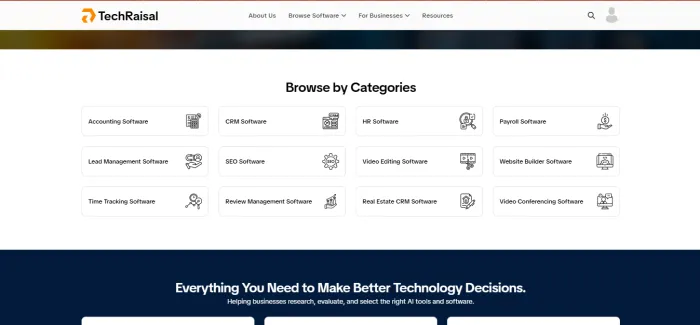
TechRaisal is a software and AI-tool discovery directory. It lets businesses browse products by category, spanning areas such as accounting, CRM, HR, payroll, and SEO software, and filter options by reviews, pricing, and features. Alongside listings, it publishes research articles and AI news through its blog, and offers vendors the ability to get listed or claim a profile.
The platform advertises a large base of user reviews, research-driven insights, and market analysis as its core value. For a buyer, the promise is consolidation. Instead of hunting across scattered sources, the relevant options, feedback, and pricing context sit in one place. That convenience is real and should not be dismissed, because time spent on research is itself a cost. But convenience and trustworthiness are not the same thing. A directory can be extremely convenient and still steer users poorly, which is precisely why the platform’s stated mechanisms, rather than its ease of use, are the right thing to examine.
The trust signals buyers look for
Before evaluating any single platform, it helps to know what business buyers generally weigh when deciding whether to trust a software listing. Research and practitioner accounts of B2B purchasing consistently point to a handful of recurring signals: authentic peer reviews from people in comparable roles, a clear explanation of how ratings are produced, transparent pricing, a visible separation between paid placement and editorial judgement, and content that is kept current rather than left to decay.
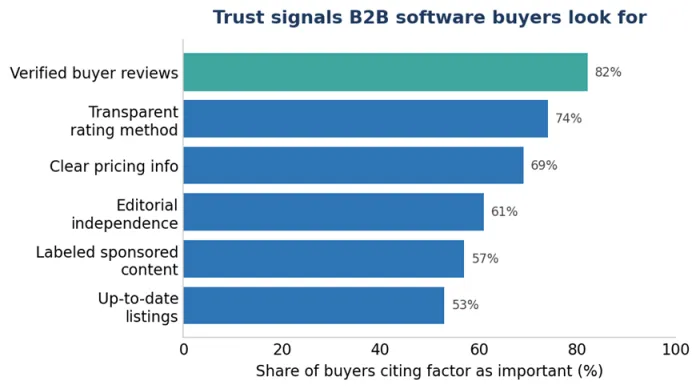
Figure 1. Trust signals B2B buyers commonly cite (illustrative). The relative ordering matters more than the exact figures.
The point of Figure 1 is not the precise percentages but the ordering. Verified reviews and a transparent method tend to sit at the top, because they speak to the two questions a buyer cares about most: can I believe what other users said, and do I understand how this score was reached. Pricing transparency follows closely, since unclear pricing is a common source of buyer frustration and a frequent reason deals stall late in the process. Disclosure practices such as labeling sponsored content sit lower in raw importance but carry outsized weight when they are absent, because a single discovered case of hidden promotion can retroactively poison trust in everything else. A discovery platform earns durable trust to the degree it addresses each of these, not just the ones that are easy to display.
How TechRaisal addresses those signals
TechRaisal’s published review methodology speaks directly to several of these factors. Rather than list them flatly, it is worth examining what each commitment is trying to achieve and what it would take for that commitment to hold.
Multiple input sources
The platform states that reviews and insights draw on real buyer feedback, editorial research, public product documentation, and market-adoption signals, rather than a single stream. The logic here is sound. Any one source can mislead. User reviews skew toward the very happy and the very angry, vendor documentation reflects the vendor’s preferred narrative, and market signals lag reality. Blending them is a reasonable hedge, because the weaknesses of one source are partly offset by the others. The open question for a reader is how these inputs are weighted in any given listing, since blending is only as good as the judgement applied to it.
A consistent evaluation framework
Products are assessed against criteria such as core features, ease of use, pricing and value, scalability, and customer support. The platform is explicit that not every product is scored on every criterion equally and that weighting varies by category. This is more honest than a one-size-fits-all score, because the right weighting for video editing software is not the right weighting for payroll. The trade-off is that variable weighting is harder for a buyer to audit, so the value of this approach depends on how clearly the reasoning behind a given score is surfaced.
Stated editorial independence
TechRaisal says sponsored listings do not influence reviews, ratings, or rankings, that vendors cannot edit, suppress, or modify reviews, and that sponsored placements are clearly labeled wherever they appear. This is the single most important commitment on the page, because it addresses the failure mode buyers fear most. The separation of commercial relationships from editorial output is what distinguishes a research tool from an advertising channel dressed up as one. The caveat, discussed further below, is that independence asserted by the platform is not the same as independence a buyer can verify from the outside.
Ongoing updates and corrections
Listings and reviews are described as being revisited periodically, with corrections made promptly when inaccuracies are identified. This matters because software changes fast. A pricing tier, a feature set, or a support reputation can shift within months, and a directory full of stale entries quietly misleads even when every entry was accurate on the day it was written. A stated commitment to updates is the difference between a living resource and a snapshot that ages badly.
Taken together, these commitments address most of the signals in Figure 1. The methodology page frames the goal as clarity rather than persuasion, which is the right framing for a platform that wants to be trusted rather than merely used. The table below maps each buyer signal to the corresponding stated mechanism, which is a useful way to see the coverage at a glance.
| Buyer trust signal | Stated TechRaisal mechanism | What to still check |
|---|---|---|
| Authentic reviews | Real buyer feedback as a core input | How reviews are verified |
| Transparent method | Published evaluation criteria | How weighting is shown per listing |
| Pricing clarity | Filtering by pricing and features | Whether pricing is current |
| Independence | Sponsored content separated and labeled | Consistency of labeling in practice |
| Freshness | Periodic review and corrections | How recently an entry was updated |
Table 1. Buyer signals mapped to stated mechanisms and the checks a reader can still perform.
Trust runs in two directions
It is worth separating the two audiences a directory serves, because the trust mechanisms benefit each differently and sometimes pull against each other. Buyers gain most from authentic reviews and an independent method. Vendors gain from credible exposure and from clearly labeled promotional options such as sponsorship and the reasons the platform gives for listing a product. These interests overlap in part, since vendors also benefit when buyers trust the platform, but they diverge whenever a vendor would prefer more control than an independent method allows.
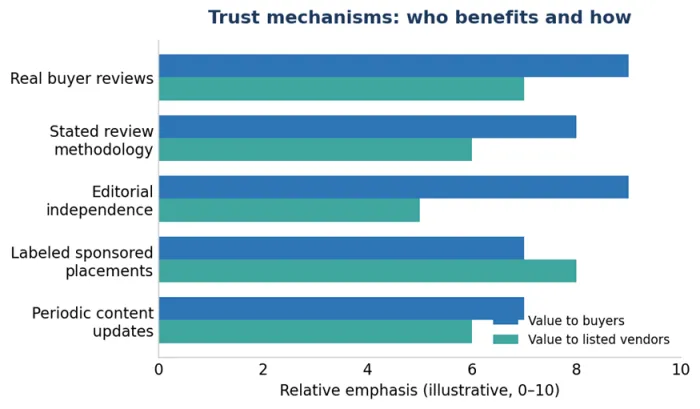
Figure 2. The same mechanisms create different value for buyers and for listed vendors (illustrative emphasis).
The tension visible in Figure 2 is the central challenge for any directory. The features that most reassure buyers, namely independence and unedited reviews, are precisely the ones that constrain what vendors can control. A vendor receiving a lukewarm review cannot have it removed, which is reassuring to buyers and uncomfortable for the vendor. A platform builds durable trust only when it resists leaning too far toward vendor interests, because once buyers suspect rankings are effectively for sale, the value of the entire directory erodes and vendors lose the credible audience they were paying to reach. In other words, protecting buyer trust is also in the long-term interest of vendors, even when it feels restrictive in the moment. TechRaisal’s stated separation of sponsored content from editorial judgement is its answer to this tension. Whether that separation holds in practice is something buyers and vendors should observe over time rather than assume.
Where to keep a critical eye
A balanced assessment has to name the limits that apply to TechRaisal and to comparable platforms alike. None of the following are unique faults of this platform. They are structural realities of the software-discovery model, and naming them is part of using any such platform well.
• Self-described policies. Editorial independence and review authenticity are stated by the platform. Stated policy is a meaningful starting point and better than silence, but readers cannot verify enforcement from the outside, so it is reasonable to treat strong claims as claims until corroborated by experience.
• Review verification depth. A large review count signals reach, but trust depends more on how reviews are validated than on how many exist. The methodology mentions real-buyer feedback without fully detailing the verification process publicly, so a reader cannot easily judge how resistant the system is to manipulation.
• Category coverage varies. Directories are strongest in categories where they hold deep data and weaker in thinner ones. A buyer should check whether their specific category is well populated, since a sparse category yields a shortlist that reflects availability of data more than genuine market breadth.
• Recency is uneven. Even with a stated update policy, not every entry can be refreshed at the same pace. Checking when a listing or review was last updated is a small habit that prevents acting on stale pricing or outdated feature claims.
• One input among several. Any directory is best used alongside vendor trials, direct reference calls, and independent sources, not as the sole basis for a purchase. The platform itself frames its role as helping decisions rather than making them, and that framing is worth taking literally.
How to use a platform like this wisely
For buyers, the practical approach is to treat TechRaisal as a research accelerator rather than a verdict. A sensible sequence looks like this:
1. Use the category and filter tools to build a shortlist rather than to pick a winner outright.
2. Read the review methodology and review policy so you understand how a rating was formed before you weight it.
3. Note which placements are labeled as sponsored, and read them with that context rather than discarding them outright.
4. Validate the shortlist through free trials, demos, and at least one reference conversation outside the platform.
5. Re-check pricing and key features directly with the vendor before committing, since these change most often.
For vendors, the value lies in maintaining an honest profile and inviting genuine customer reviews rather than relying on placement alone. The platform allows vendors to claim a profile and get listed, and the most durable strategy on any review-driven directory is to earn strong feedback rather than to manufacture it, because buyer trust, once lost, is expensive and slow to rebuild.
The bottom line
TechRaisal builds online trust the way credible discovery platforms generally do: by consolidating real reviews, publishing a transparent evaluation method, declaring editorial independence, labeling paid placement, and committing to keep content current. Those are the right mechanisms, and they map well onto what buyers actually care about, as Table 1 shows. The honest caveat is that trust is ultimately earned through consistent practice over time, and much of what underpins it is stated by the platform rather than externally auditable by a visitor. That is not a reason for cynicism. It is a reason for the ordinary diligence any significant purchase deserves.
Used as one well-understood input among several, with its methodology read and its claims treated as claims, the platform can meaningfully speed up sound technology decisions, which is exactly the role it claims for itself. You can explore the platform and its standards directly via techraisal.com, its About page, and the review methodology.