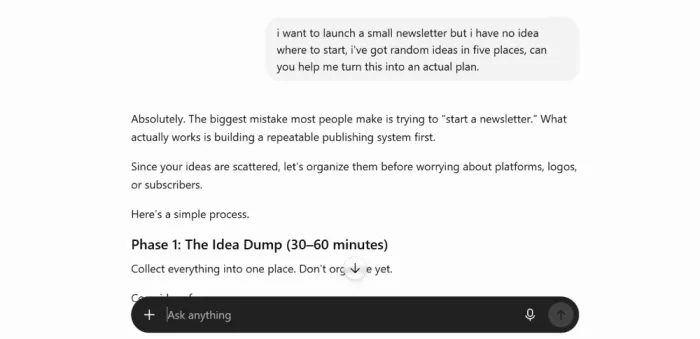
A few months ago I caught myself doing something I never decided to do. I had a half-formed question, the kind I used to drop into Google, and my hands opened a chat window instead. Not to find a link. To think out loud.
That small switch sat with me for a week.
Then I started seeing it everywhere. A friend drafts every hard email by talking it through with an assistant before she writes a single line. A founder I know runs each big decision past a model before she runs it past her co-founder. Nobody sent a memo announcing a new habit. The habit arrived on its own and moved in.
I am not usually early to anything. If it reaches me, it has reached a lot of people, and it happened with no launch event and no headline.
The numbers back the quiet up. ChatGPT crossed a billion monthly users in June 2026, per Reuters, the fastest any app in history has reached that line, quicker than TikTok or Instagram. It now moves more than 2.5 billion messages a day. Nobody threw a parade. A billion people just showed up.
And it is not only me stacking those walls. Around 70% of ChatGPT use has nothing to do with work, by Zapier's 2026 read of usage patterns. The lock-in forms in personal time, on personal questions, which is the hardest kind to walk away from. You do not churn out of your own memory.
So here is the claim I want to earn over the next few thousand words. The companies behind these tools have stopped fighting over which model is smartest. They are fighting to become the place where your thinking begins, and the place it continues after you close the laptop. That is a different contest with a different prize, and most of the coverage I read walks straight past it.
Let me start where the shift first became visible to me.
The day the blank page moved
For most of my working life the blank page had one job. It waited. A search bar waited for a query. A document waited for words. A spreadsheet waited for numbers. The software held whatever came out of your head after the thinking was already done.
AI chat quietly broke that deal. The page stopped waiting and started answering back. It questions me. It reorganizes my mess. Every so often it flatly disagrees. My first draft of an idea now happens as a back-and-forth instead of a monologue on an empty screen.
The change is easy to miss because nothing on the screen looks dramatic. A text box is still a text box. What changed is which direction the words flow.
Think about how strange this would have sounded in 2015. Software that pushes back. A blank field with opinions about your half-baked plan. The interface used to be a mirror that reflected your own words back at you. Now it behaves more like a colleague who read the brief and came to the meeting with questions.
Look at the three stages I lived through, because the sequence matters. Search engines answered questions I already knew how to phrase. Productivity apps stored and shaped decisions I had already made. AI platforms slid one step earlier in the process, into the moment a thought is still forming, before it is clean enough to type into a search box.
That earlier position is the whole game, and it sets up everything below. Whoever sits at the moment before an idea is finished has a claim on the idea itself. Hold onto that, because I come back to it when I reach continuity.
What a "default thinking space" actually means
I kept leaning on the phrase "thinking space" before I had defined it, so let me pin it down.
A default thinking space is the first place you go when a thought needs somewhere to land. It carries four traits I can point at directly:
- It takes input while the idea is still rough, before you have tidied it up for anyone else to read.
- It processes that input by reasoning back at you rather than filing it away in a folder.
- It hands you something usable at the far end: a draft, a plan, a decision, or just a cleaner version of the mess you walked in with.
- It remembers. What you built yesterday is still sitting there today.
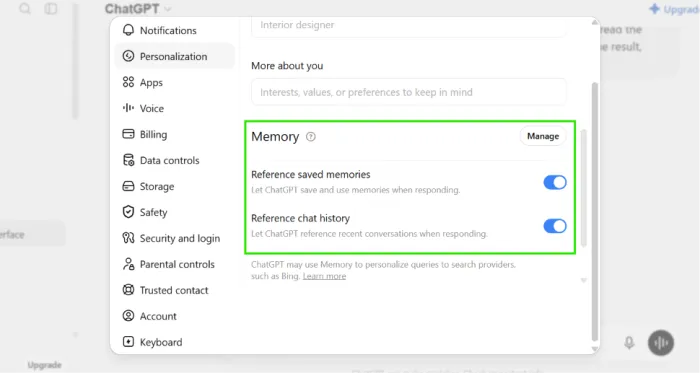
That last trait, memory, is the quiet one. It is also the reason this entire competition exists. A tool you forget is a tool you can swap out on a Tuesday afternoon. A space that holds six months of your thinking is far harder to leave behind. That pull is exactly what the next section digs into.
Why the platforms want to own this spot
Companies do not pour billions into a product to be pleasant. They pour it in to be necessary. Sitting at the front of your thinking makes a product necessary in four concrete ways, and I have felt each one from the inside as a user.
Retention that runs on habit, not contracts
Once your thinking starts inside a product, leaving costs more than a cancelled subscription. It costs the context you built. I have close to three years of half-projects and saved threads inside one assistant. Moving elsewhere would mean rebuilding a memory from scratch, not copying a folder of files across. That is the strongest lock-in there is, the kind you construct yourself without ever noticing the walls go up.
Your context is the actual product
Every question you type is a signal. Your history is a map of what you care about and what you are quietly planning next. A platform holding that map can tailor itself to you in ways a fresh tool cannot manage on day one. The conversation is the data, and the data compounds with every session.
I ran a small test on myself last month. I asked an assistant I had used for a year to describe my working style, and it did the job better than I could have. It knew the projects I abandon, the arguments I over-explain, the phrases I lean on too hard, and the exact hour of day my writing gets sharper. A brand-new tool would need months of my attention to learn a fraction of that. The old one already knew, and knowing is the moat.
This stopped being a power-user story a while ago. OpenAI reported that the share of ChatGPT users with typically feminine names climbed from 37% at the start of 2024 to 52% by mid-2025, and that uptake in the lowest-income countries was growing more than four times faster than in the richest. The map I described is being drawn for an ordinary, wide slice of people now. Early adopters were never the point.
One surface instead of six tabs
I used to ricochet between a search tab, a notes app, a live document, and a separate chat window. Those four are collapsing into a single surface. Notion pulled AI straight into the workspace where the notes already lived. Google slid Gemini inside the documents and the inbox people opened anyway. The pitch underneath is one sentence long: stop switching, start staying.
The habit sets like concrete
The last pull is the quietest and the deepest. After enough repetitions, the place you think becomes part of how you think. Reaching for a chat window is automatic for me now, the same way reaching for a phone in a dull moment became automatic years ago. A habit at that depth outvalues any single feature, because a rival can copy a feature overnight and cannot copy a reflex.
Those four pulls explain the spending. They do not yet explain the real prize, which sits a level above retention. Continuity is where I am headed next.
The real prize is continuity of thought
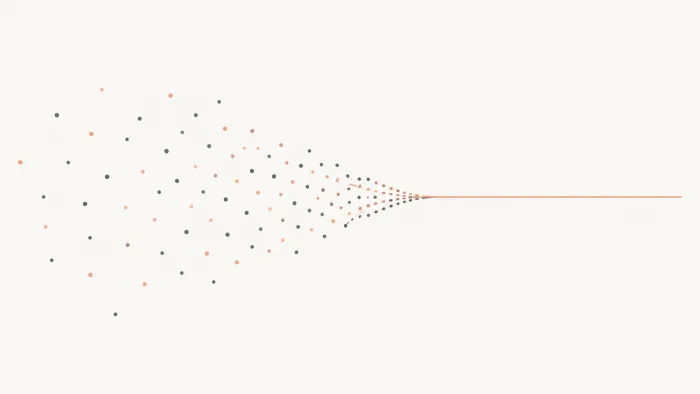
Here is the single line I would keep if an editor made me cut everything else. The winner will not be the smartest assistant, it will be the one that carries your thinking forward when you step away and come back to it days later.
Intelligence, at the frontier, is close to sorted. Several models now reason well enough for almost everything I throw at them, and the gap between them shrinks every quarter. Raw cleverness has stopped being the thing I actually choose on.
Watch how the marketing has already shifted. A year ago the headline feature was a bigger model with a higher score on some test. This year the headline features are memory, projects, saved context, and the quiet ability to pick up exactly where you left off. The labs are telling you, in their own launch notes, that the fight has moved. They stopped selling the engine and started selling the garage the engine lives in.
Continuity does not shrink like that. Picture two assistants. One remembers the argument I was half-building last Tuesday and picks it up mid-sentence this Tuesday. The other greets me politely as a total stranger. The first one has me, and not because it scores a single point higher on any benchmark. It has me because it is continuous.
That reframes the whole race. The question moves away from "which model gives the best single answer" toward something quieter and stickier: which product becomes my second memory. Whoever wins that turns into a kind of external mind, the place my thinking lives in the gaps between sessions.
An external mind is a strange thing to rent. I find the prospect useful and a little unsettling at the same time, and I get to the unsettling half shortly.
How the big players are actually competing
Enough abstraction. Let me name what I see on the field, because vague strategy talk never helped anyone decide anything.
The contenders are chasing continuity from four different directions. A table lays it out more cleanly than a paragraph can:
| Approach | What it looks like in practice | Where you can watch it happen |
|---|---|---|
| Memory-first | The assistant recalls facts about you and old chats, then raises them without being asked | ChatGPT memory, Gemini personalization across Google apps |
| Workspace integration | Notes, files, chat, and reasoning all share one home so thinking and storage sit together | Notion AI, Claude Projects, Microsoft Copilot inside Office |
| Agentic execution | The assistant refuses to stop at an answer and takes the next action for you | Claude and ChatGPT agent modes, task-running assistants |
| Ecosystem lock-in | Connected apps and integrations pull your other tools inside the AI layer | The GPT app ecosystem, Gemini across Workspace |
Read that table as one contest fought on four fronts at once. Memory makes the space personal. Workspace integration makes it central. Agentic execution makes it active. Ecosystem lock-in makes it painful to leave. A platform that lands all four does not have a better chatbot on its hands. It has your workflow.
The interesting part is that no single company has cleanly taken all four yet, which is why the field still feels wide open on any given month. Notice what is missing from every row, though. None of these fronts is "we built a smarter model." That absence is the entire point of the previous section, and it is why I keep circling back to continuity instead of capability.
You can watch the contest move in the traffic. ChatGPT held 76.4% of global AI web traffic a year earlier and 52.7% by late May 2026, on Similarweb's figures reported that June. A near-monopoly slid into a real race inside twelve months. That is what an open field looks like from the outside.
What we give up when thinking has a landlord
I have spent five sections on why this land grab makes perfect sense for the companies. Fairness demands I ask what it costs the rest of us. Four things worry me, roughly in order of how much sleep they cost.
Thinking you no longer do yourself
When the opening move on every problem becomes "ask the assistant," the muscle that used to make that first move weakens from disuse. I catch it in myself. Handed a blank problem, my instinct now is to summon help before I have sat with the discomfort alone for even a minute. Convenience and atrophy show up holding hands.
We have older versions of this bargain to learn from. Lean on a calculator for a decade and some arithmetic fluency quietly slips. Lean on turn-by-turn navigation and your built-in sense of direction goes soft. A thinking space runs the same trade at a higher target, aimed at judgment itself rather than at sums or streets. The trade can absolutely be worth it. It is still a trade, and it is worth naming out loud before you sign.
Your ideas living on rented land
If my thinking piles up inside one company's product, my intellectual history becomes a tenant there. Terms of service change. Prices climb. The feature I built a daily habit around can vanish in a quiet product update on a Thursday. I own the thoughts. I only rent the place that remembers them for me.
A record of how you reason
Search knew what I was looking for. A thinking space knows how I reason, where I stall, which questions I circle for an hour, and which half-formed opinions I never say out loud to another human. Set that beside an old browser history and it is a far more intimate file, and it sits on servers I will never control or even see.
A slow drift toward one way of thinking
When tens of millions of people reason through the same handful of assistants, tuned by the same small cluster of labs, our styles of thought creep toward a shared middle. The tool that helps you think also, without any announcement, shapes how you think. Sounding an alarm about a monoculture of reasoning feels slightly absurd while I type this into an assistant, and yet here I am, sounding it.
None of this pushes me toward logging off. It tells me the convenience comes with an invoice attached, and I would rather read that invoice now than get ambushed by it in five years. Which points straight at where I think all of this is heading.
Where this goes next
A few predictions you can hold me to.
Work stops being document-first and becomes conversation-first. For decades the file was the unit of work; the thread is quietly taking its place. My saved chats already work as a personal knowledge base I dig through before my own notes.
Teams get shared thinking layers. Right now my assistant knows only me. Soon it holds a whole team's context, so a new hire can ask the room's memory why a decision got made two years before they arrived and get a real answer.
This is not a far-off bet. Around 92% of Fortune 500 companies were already running ChatGPT by early 2026, with paid enterprise seats up roughly ninefold in a year, on OpenAI's own reporting. The install base for a shared team memory is already sitting inside most large organizations. The memory layer is the part still being wired in.
Search slides into the back seat. About 68% of US Google searches ended without a single click by May 2026, on SparkToro's analysis, up from roughly 45% ten years earlier. AI Overviews sit on a bit over a fifth of all searches, and Pew Research found in July 2025 that only 1% of people click a link inside one when it shows. So the front door narrows. Search turns into the fallback I reach for once the assistant has run dry, well down the order it used to lead.
The loop closes on discovery too. This article was written, in part, to be found. For a decade that meant climbing a list of blue links. Now it means being the source an assistant quotes when a stranger asks it a question in plain words. The place where thinking happens is becoming the place where thinking gets discovered.
Final Thought
I never chose my thinking space on purpose. It chose itself, one convenient session at a time, until leaving would have meant erasing part of my own memory. That is worth sitting with, because the same drift is reaching most people I know, quietly, with no decision anyone could point to.
So the useful question stops being which assistant is smartest this month. The better one is which assistant you would trust to hold your half-formed ideas for the next ten years, and whether you are at peace with the answer. Pick that one on purpose, before it picks you.