
Publishing on a schedule is the hardest part of content. Ideas are rarely the bottleneck. The grind is turning one idea into a blog post, then a week of captions, then a script for video, again and again, without going quiet or burning out. That treadmill is exactly where an AI writing assistant earns its keep.
RedeepSeek is an all-in-one AI assistant that handles the whole content trio in one place: long-form blogs, short social captions and spoken scripts. It generates writing tuned to your brand voice, checks facts with live web search, and works across more than 50 languages, all from a simple chat interface. This guide is a practical playbook. You will see where it fits, how to use it for each format, and a set of copy-paste prompts you can adapt today. The site lives at redeepseek.io.
| REDEEPSEEK AT A GLANCE | |
|---|---|
| What it is | An all-in-one AI assistant for content, research, coding and analysis, built on next-generation large language models. |
| Best for content | Blogs, social captions, video and podcast scripts, plus emails, ad copy and product descriptions. |
| Standout for writers | Brand-voice content generation, web search with cited sources, 50+ languages, and custom personas and templates. |
| Pricing | Free trial ($0), Starter ($10/mo), Professional ($18/mo), and a Custom / API plan. Annual billing saves 20 percent. |
| Privacy | End-to-end encryption, SOC 2 infrastructure, conversations not used to train models, and delete-anytime control. |
Why writers reach for RedeepSeek
Stripped of the marketing, a few capabilities matter most for writing. Content generation produces blogs, emails, ad copy, social posts and product descriptions tuned to your brand voice. Web search integration pulls current information and returns answers with cited sources you can verify, which is what keeps a blog accurate. Support for 50-plus languages makes localization trivial. Document analysis turns a PDF, brief or spreadsheet into a usable starting draft. Custom personas and templates lock in your tone, and workflow automation lets you batch the repetitive parts. Together they remove the blank-page tax and shrink the time from idea to draft.
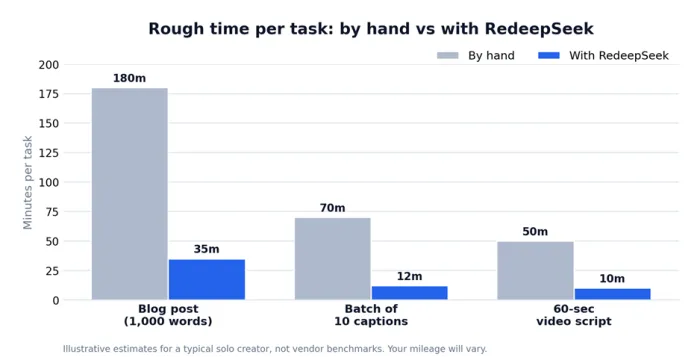
The exact numbers will vary, but the shape holds: the heaviest lift is the first draft, and that is the part an assistant compresses the most. You spend your time directing and editing instead of staring at a cursor.
The content trio
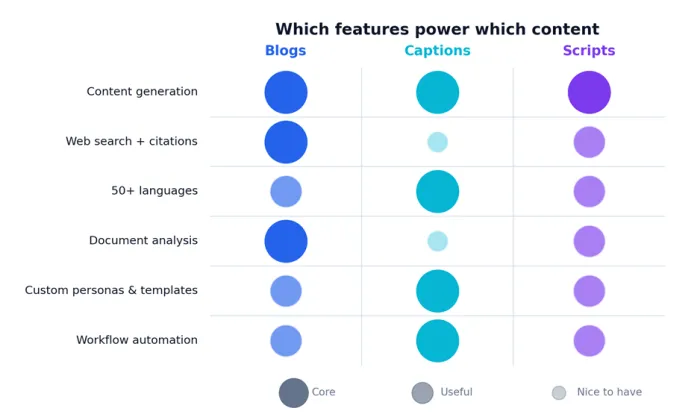
Blogs, captions and scripts are three different jobs, and different features carry the weight in each. The map below shows where each capability matters most. Content generation is core everywhere. Blogs lean hardest on web search and document analysis for depth and accuracy. Captions reward languages, saved personas and automation because you produce them in volume. Scripts sit in between and live on structure.
Four tools in one: the deep dives
1. Blog posts
Depth, structure and accuracy
The best results come from treating RedeepSeek as a collaborator, not a vending machine. Drive the post in stages rather than asking for a finished article in one shot.
• Brief it. Give the audience, goal, target keyword, voice and rough length before anything else.
• Outline first. Ask for a section outline and approve or adjust it before the draft. This is the single biggest quality lever.
• Draft in sections. Generate section by section so you can steer each part, or request the full draft once the outline is right.
• Fact-check with web search. Ask for current data and citations, then confirm the important claims yourself before publishing.
• Edit for voice. Rework the draft so it sounds like you, with your examples and point of view, not a generic template.
| PROMPT RECIPE SEO blog draft |
You are my brand's content writer. Brand voice: [confident, friendly, no jargon]. Audience: [who they are]. Write a [1,200]-word blog post titled "[title]". Goal: [educate and rank for the keyword "[keyword]"]. Use H2 and H3 headings, short paragraphs, one practical example per section, and a clear takeaway. Open with a hook that names the reader's problem. End with a one-line CTA: [your CTA]. Before writing, give me a 6-point outline to approve. |
Pro tip. Save your brief as a reusable persona or template so every future post starts from the same voice and rules.
2. Social captions
Hooks, volume and platform fit
Captions are a numbers game built on strong hooks. This is where batching pays off: generate many at once, then keep the best. The smartest move is to repurpose, not start fresh.
• Repurpose from the blog. Feed the post and ask for platform-specific captions drawn from it.
• Tailor per platform. Instagram wants punchy and visual, LinkedIn wants story-led and professional, X wants short and thread-ready, and Reels or TikTok want spoken-style hooks.
• Lead with the hook. A scroll-stopping first line, two or three value lines, then one clear CTA.
• Ask for variations. Request 3 to 5 hook options and a relevant hashtag set so you can test what lands.
| PROMPT RECIPE Caption batch from a blog |
Act as a social copywriter for [brand]. From the blog post below, write [5] Instagram captions and [5] LinkedIn posts. Each one: a scroll-stopping first line, 2 to 3 short value lines, one CTA, and 5 relevant hashtags. Match this voice: [voice]. Keep Instagram under 125 words and LinkedIn under 200 words. Blog: [paste the text or link]. |
Pro tip. Run the batch through a saved brand persona so 10 captions still sound like one consistent voice.
3. Scripts
Structure, retention and pacing
Scripts live or die on structure. Short sentences, a strong hook and a clear payoff keep people watching or listening. Tell RedeepSeek the format and let it build to a proven shape.
• Set format and length. A 30 to 60 second Reel, a 5 to 8 minute YouTube video, or a podcast segment each need a different rhythm.
• Use a hook, value, CTA spine. For short form, a 3 second hook is non-negotiable.
• Ask for spoken lines only. Put B-roll and visual cues in brackets, and keep sentences short for breath and pacing.
• Get a hook menu. Request five opening hooks and pick the strongest, then localize the script if you publish in other languages.
| PROMPT RECIPE Short-form video script |
You are a short-form video scriptwriter. Turn the idea below into a [45]-second Reel script. Structure: a 3-second hook, three quick value beats, and a CTA. Write spoken lines only, add [B-roll] suggestions in brackets, and keep sentences short for retention. Tone: [energetic, plain English]. Then give me 5 alternative hooks. Idea: [your idea]. |
Pro tip. Paste a transcript of a video that performed well and ask RedeepSeek to match its pacing and structure.
A repeatable workflow
The same five steps work for every format. The two that matter most are approving the outline before the draft and editing the result for your own voice. Skip those and you get generic output. Keep them and the assistant becomes a genuine force multiplier.
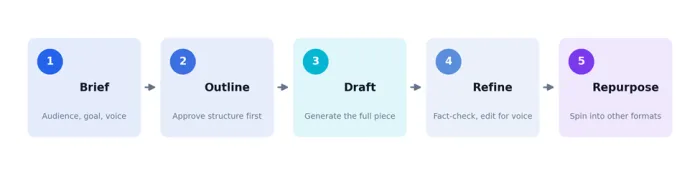
Brief the assistant on audience, goal and voice. Approve a structure. Generate the draft. Refine it with fact-checking and a voice edit. Then repurpose the finished piece into other formats instead of starting over.
Turn one idea into ten
The highest-leverage habit in content is repurposing. One solid blog post is raw material for a week or more of everything else. Ask RedeepSeek to adapt the same core idea to each format and audience, keeping the message but changing the shape.
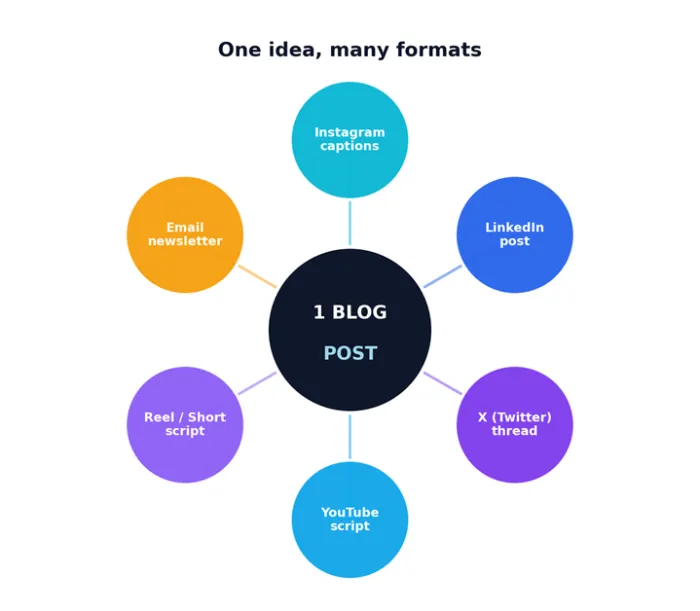
A single post becomes Instagram captions, a LinkedIn story, an X thread, a YouTube or Reel script, and an email newsletter. Because the assistant already has the source, each new format takes minutes, and your message stays consistent across every channel.
Five habits for better output
1. Give it a voice. Build a custom persona or template with your tone, audience and a short list of dos and donts, then reuse it.
2. Show, do not just tell. Paste a sample of your best writing and ask the assistant to match the style.
3. Outline before drafting. Approve the structure first. It prevents long, off-target drafts.
4. Use web search for facts. Ask for current sources and citations, then verify them independently.
5. Iterate in passes. Structure first, then substance, then voice and polish. One prompt rarely nails all three.
Plans and pricing for writers
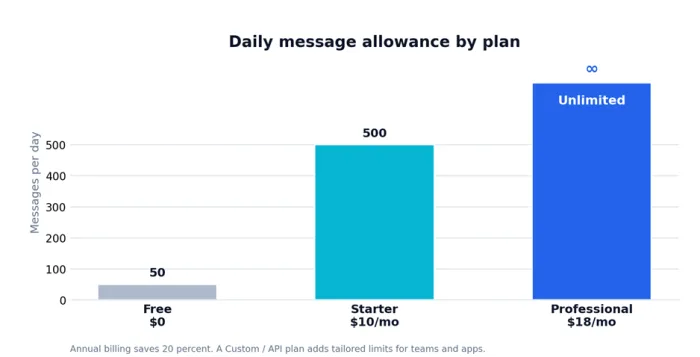
Pricing is simple and scales with output. Start on the free trial to test the fit, move to Starter for everyday solo writing, and step up to Professional when you need unlimited volume, document analysis and team features.
| Plan | Price | Daily messages | Best for | Key extras |
|---|---|---|---|---|
| Free trial | $0 | 50 | Testing the tool | Basic content generation, web interface |
| Starter | $10/mo | 500 | Everyday solo use | Web search, content suite, 50+ languages, 15-day history |
| Professional | $18/mo | Unlimited | Serious creators, small teams | Document and image analysis, custom personas, team workspace (5), priority support |
| Custom / API | Custom | Tailored | Agencies and apps | REST API, SSO and SAML, custom limits, dedicated manager |
Annual billing saves 20 percent, and new subscribers get a 7-day refund window, so trying a paid tier is low risk. For most active solo creators, Starter covers the daily load; Professional is the pick once you are publishing across several channels or working with a small team.
Keep it honest: limits and good practice
AI speeds up the draft. Your judgment is still what makes the work good and trustworthy. A few ground rules:
• Verify facts. Web search with citations helps, but confirm critical claims, statistics and quotes yourself before publishing.
• Edit for originality and voice. Treat every output as a first draft and rework it so it is genuinely yours, not generic.
• Mind disclosure. Some platforms and clients expect transparency about AI assistance, so check the rules that apply to you.
• Protect sensitive data. RedeepSeek encrypts conversations and says it does not train on them, but avoid pasting confidential material you are not cleared to share.
• Do not publish raw. The creators who win use AI to draft faster, then add the human examples, judgment and personality that readers and algorithms reward.