The Monday I Stopped Opening Tabs
Last quarter I watched a teammate build our Monday report the slow way. She opened the CRM, exported a sheet, scrubbed the duplicates, pulled figures from two dashboards, dropped them into slides, wrote a summary, then emailed leadership. Ninety minutes. Six tools. One person doing the job of an integration layer.
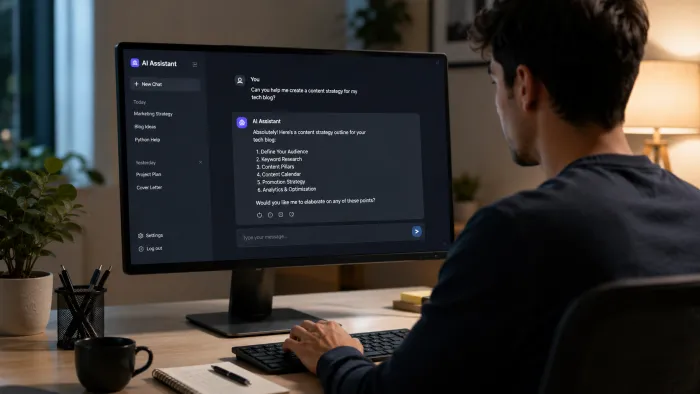
Here is the claim I want to defend across this piece. Work is moving away from operating software and toward describing outcomes. The interface of the next decade is a sentence, not a screen. You say what you want, and a system assembles the steps behind it.
I did not believe that two years ago.
What changed my mind was watching the same report get built from a single instruction while I made coffee. This article is the walk from skeptic to convinced, and it is the case for why the app-by-app way of working is on its way out. I will show you the pain that started the shift, the mechanism that replaces the old way, the products already doing it, and the version of your desk that arrives next. Each section leans on the one before it, so read in order.
I am not a futurist by trade. I run projects, I ship work, and I count the hours a task eats. That practical lens is the only one I trust here, so every claim below comes with something I have watched happen rather than a slide from a keynote.
The Quiet Tax of Too Many Tools
The average company now runs dozens of SaaS products, and the bigger ones run into the hundreds. Every one was sold as a time-saver. Stacked together, they created a job nobody applied for: moving data between screens.
I started noticing that tax everywhere.
Context switching burns focus every time you jump from your inbox to a spreadsheet and back. Data sits in fragments, so a plain question like “how did the west region do?” needs two or three logins before you get an answer. New hires spend their first weeks learning software instead of the actual work. The highest-paid people on a team lose hours each week to copy-paste that a script could finish in seconds.
Take one small request from my own week. A director asked why a deal slipped. The answer lived in four places at once: the note in the CRM, the thread in email, the number in the finance sheet, and the timeline in the project tool. Answering a one-line question meant opening four apps and holding the pieces together in my head. Multiply that by every question a team asks in a day and the tax adds up fast.
Put the old way and the emerging way side by side and the gap is hard to miss.
| The app-driven way | The conversation-driven way | |
|---|---|---|
| How a task starts | You pick a tool and open a screen | You state the outcome you want |
| Where the data lives | Split across many separate logins | Pulled together the moment you ask |
| What you operate | Menus, fields, buttons, and filters | Plain language |
| What you get back | A file you still have to assemble | A finished result to review |
The right-hand column is not a prediction. It already exists in pieces, which I will get to shortly. First, the idea that makes the whole thing possible.
Intent Becomes the Interface
Every app is a translator. It takes what you want and makes you re-express it as clicks and form fields. You already hold the goal in your head. The software forces you to spell it out in its own grammar.
Language models remove that translation step. You say the goal in your own words, and the system works out which buttons to press. Some people call this intent-based computing. The label matters less than the behavior. The machine adapts to you instead of forcing you to adapt to it.
A service you call has a useful property. It shows up when needed and disappears when the job is done. You stop navigating a permanent home screen of icons and start summoning capability on demand. The tool becomes a verb rather than a place.
Two shifts sit inside that idea. The interface stops being visual and becomes verbal. And the tool stops being a place you visit and becomes a service that runs when called.
This is where the title of this piece earns its keep. Workflows stop being a set of apps you march through in order. They become a request you make and a result you receive. The screen fades. The sentence takes over.
Intent sounds abstract until you watch it run, so here is a concrete example.
One Sentence, Ten Steps
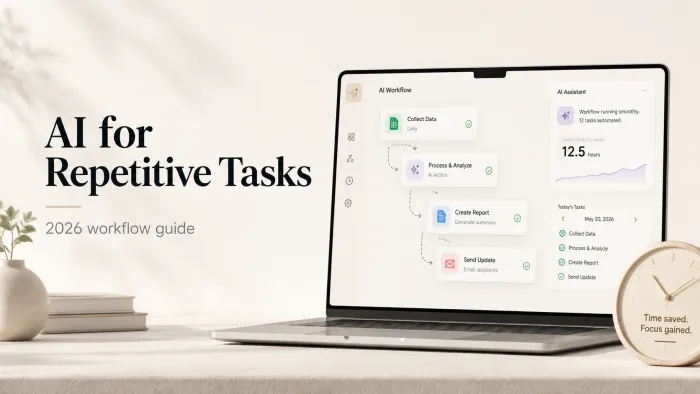
Picture the Monday report again. Instead of ninety minutes across six tools, the instruction is a single line:
“Prepare this quarter’s sales report and send the four biggest insights to leadership.”
Behind that one sentence, a lot happens without a single click from me:
- It reads the raw numbers from the CRM and the finance sheet
- It cleans the data and flags anything that looks off
- It runs the comparisons across quarters
- It builds the charts and drafts a short written summary
- It packages the top findings and emails them out
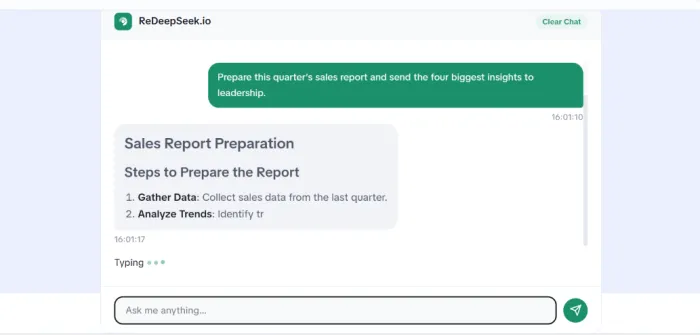
The output is not a folder of pieces waiting for me to glue together. It is the finished thing. My role changed from operator to editor. I read what came back, I push on the parts I disagree with, and I approve it or send it back.
The catch is verification. A finished draft that looks right can still be wrong, so the editor role is a safeguard rather than a demotion. I spend less time making the report and more time making sure it is true.
Swap the domain and the shape holds. A marketer types “draft next week’s launch emails and schedule them,” and the same pattern runs: gather the product details, write the copy, build the sequence, queue it up. The instruction is different. The move from operator to editor is the same.
That single move, from assembling work to reviewing it, is the whole argument in miniature. Hold onto it, because everything below is a variation on that theme.
The example only holds together because of machinery I skipped past. Time to open the hood.
Under the Hood: How Answers Become Actions
A chatbot answers. An agent acts. That one-word difference is the engine of everything above.
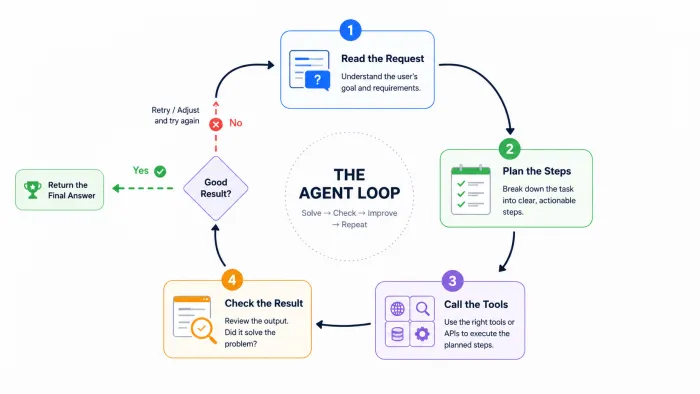
When you hand a modern AI system a goal, it does not stop at a text reply. It plans a route, then runs that route against real tools. The loop looks like this:
- It reads the request and works out what you actually want
- It breaks the goal into an ordered set of steps
- It calls the tools it needs, such as a CRM, a spreadsheet, a calendar, and an email client
- It checks whether the result matches the goal
- It retries or adjusts when a step fails
Two ingredients keep that loop honest. Memory lets the system carry context across steps, so it does not forget in step five what it learned in step two. Orchestration is the layer that sets the order and hands work from one tool to the next. Put memory and orchestration together and a clever text generator becomes something that finishes jobs.
There is a spectrum hiding in that loop. At one end, the system suggests and waits for you to click. In the middle, it acts and reports back for approval. At the far end, it runs the whole process and pings you only when something breaks. Most useful tools today sit in the middle, and the reason is trust. The retry step is what earns the move rightward, because a system that catches and fixes its own mistakes is one you can hand more rope.
None of this is a forecast I am selling you. It ships in products I open every week, which is where I want to go next.
The Proof Is in Your Search Bar
The tools are already here. Microsoft Copilot builds slides and drafts email inside Office. ChatGPT and Gemini plan and write across whole tasks. Notion AI turns a rough note into a structured document. Zapier wires apps together from a plain-language description. Cursor writes and edits code from an instruction.
The clearest proof, though, sits in a place you use every day. The search box.
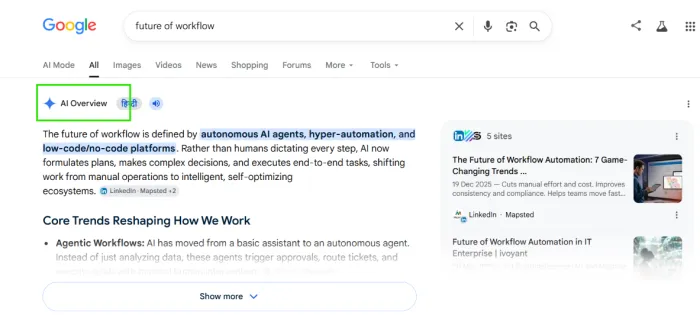
Google search is turning from a list of links into a written answer. Ask a question and an AI Overview often replies at the top of the page, stitched together from several sources. Search Engine Land puts these overviews at around 16% of searches, and other studies push that figure higher for comparison-style and high-intent queries. That is software answering the goal directly instead of handing you ten doors to open.
This changed how I publish, and it should change how you read the rest of this article. When Google answers on the page, ranking first stops guaranteeing a visit. Analyses from Semrush and Ahrefs, widely summarized through early 2026, show click-through rates on informational queries falling by roughly a third to a half once an AI Overview appears. Close to 60% of searches now end with no click at all.
Two points make this concrete. The same behavior shows up in ChatGPT and Perplexity, where people research purchases by asking rather than by browsing. And the overlap with old-style ranking is strong: SEO studies through 2026 found that more than half of the pages cited inside AI answers already rank in Google’s top results. Strong classic content still feeds the answer box. The job now is to be the source the answer quotes rather than a link on a page few people reach.
Here is the part that ties back to my thesis. Search is the most public example of the move I described earlier, the move from operating software to stating intent. The list of blue links was an app you learned to work. The answer box is a conversation. When the world’s most-used interface bends this way, the tools you work inside bend faster.
The shift does not land evenly across jobs. Some kinds of work feel it first, and that is worth mapping.
Where It Lands First
Some roles are mostly the assembly of information, and those move earliest. I sorted the functions I watch most closely into a simple before-and-after.
| Function | The old workflow | The prompt-driven version |
|---|---|---|
| Marketing | Build each campaign asset by hand | “Launch a campaign for this product and draft the emails” |
| Sales | Update the CRM and chase records manually | “Summarize this account and log the next steps” |
| Finance | Pull the data and build the forecast in a sheet | “Forecast next quarter and explain the swing” |
| Engineering | Write and test in separate passes before shipping | “Build this feature and open a tested pull request” |
| HR | Screen applicants and schedule across tools | “Shortlist these applicants and book the interviews” |
The pattern under every row is identical. A person used to move between tools to produce a result. Now the person states the result and supervises the machine that produces it. The work shifts up a level, from doing the steps to defining and checking them.
Not everything moves at the same speed. Work that runs on judgment and human relationships resists the pattern longer, because the value there is the person, not the assembly. A closing conversation with a nervous client does not compress into a prompt. The assembly-heavy tasks around it do.
A fair objection lands right here. If AI does the assembling, do the apps die? No. They move.
Software Becomes Plumbing
Apps are not going to vanish. They are going to go quiet.
The CRM still stores the records. The spreadsheet still runs the math. What changes is that you stop touching them directly. They slip behind the conversation and become infrastructure, called by an agent rather than clicked by a human.
Think about electricity. You do not visit a power plant or manage a substation to charge a phone. You plug in. An enormous grid is doing complex work, and your entire interface with it is a socket on the wall. Software is heading for the same place. The heavy machinery keeps running underneath, and your interface with it shrinks to a request.
One caution sits inside the analogy. A socket is only as good as the grid behind it. If the apps underneath are messy, an agent built on top inherits the mess. The quiet layer still has to be well-built, which is why the companies that win will be the ones that cleaned up their data and their systems before draping a conversation over the top.
That is the deeper meaning of the title. The future of workflows is not the apps themselves, which will hum along in the background for years. It is the conversation laid over the top of them.
If the software recedes, the skills that used to run it recede with it. That has real consequences for people and for the companies they work in.
New Skills, New Org Charts
When the tools go quiet, the value of knowing them drops. I spent years getting fast inside specific software. That muscle memory matters a little less every month.
Here is what rises in its place, split by who feels it.
| For the person doing the work | For the company |
|---|---|
| Thinking in outcomes, not features | Redesigning workflows around outcomes |
| Writing clear instructions a machine can act on | Building a data and integration strategy |
| Judgment about when the output is wrong | Governance and access control |
| Editing and approving instead of assembling | Deciding which calls stay human |
The person who wins here is the clearest thinker with the sharpest eye for a wrong answer. Speed inside a tool stops mattering much when you barely touch the tool. Prompting is a real skill, and the deeper one underneath it is knowing what good looks like, because the machine will hand you plausible garbage often enough that judgment becomes the job.
A concrete version for a person: the analyst on my team stopped spending Friday afternoons formatting the weekly deck. She now spends that hour deciding which two numbers actually deserve leadership’s attention. Her output went up, and the part of her job a machine cannot copy grew.
Companies face a heavier lift than individuals. Redesigning a workflow around outcomes means rethinking who approves what, where data lives, and how far an agent is allowed to act on the company’s behalf. The firms that treat this as a plumbing upgrade will fall behind the ones that treat it as a redesign.
All of these points somewhere specific. Here is the desk I think we are walking toward.
The 2030 Desk
Picture your work surface a few years out. The dashboards you check every morning are mostly gone, replaced by an assistant you ask for the state of things. Reports do not get built anymore; they get requested. The routine processes that run on a schedule and rarely need a human start running themselves, surfacing only when they hit something strange.
The assistant becomes the operating system for your work. It sits above every tool you own and speaks for all of them. You bring the intent and the judgment. It brings the execution.
A second prediction, more cautious. As execution gets cheap, judgment gets expensive, so the people who keep the sharpest sense of when the machine is wrong will pull ahead of the ones who simply talk to it most.
I will make one concrete prediction to close. The most-used piece of software on your machine in 2030 will be the one you never think of as software, because the only thing you will ever do with it is talk.
Final thought
None of this happens on a fixed date. It arrives task by task, quietly, until one day you notice you have not opened a tool you used to live in.
So I would not wait for 2030 to change how you work. Pick one workflow you dread, maybe the weekly report or the inbox triage, and hand the assembly to an assistant this week. Watch what it gets right. Watch what goes wrong. That single experiment will teach you more than another article like this one.
There is a version of the future where I am wrong, and I want to be honest about it. If the tools stay unreliable, or if companies never clean up the messy data sitting underneath them, the conversation layer stalls and we keep clicking. I do not think that is where we land. The distance between "impressive demo" and "colleague I trust" is closing faster than it ever closed for the software this replaces.
The people who do well will treat this as a skill to build now, while it is early enough to have an edge. The rest will meet it later, on someone else's terms.