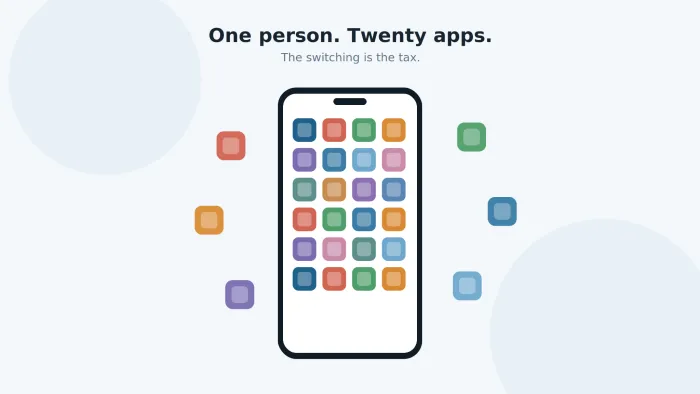
Last Tuesday I tried to count the apps I opened before lunch. Email came first, then my calendar to check a meeting, then a banking app to confirm a payment cleared, then two messaging tools, a notes app, a browser holding nine tabs, a spreadsheet, and a food-delivery app I abandoned halfway through ordering. By eleven in the morning I had lost track of the one thing I had sat down to do. Each app wanted its own login and its own layout, plus gestures my thumbs had learned by rote. None of them talked to each other. I was the glue holding my own morning together, and the glue was tired.
I don’t think I’m unusual.
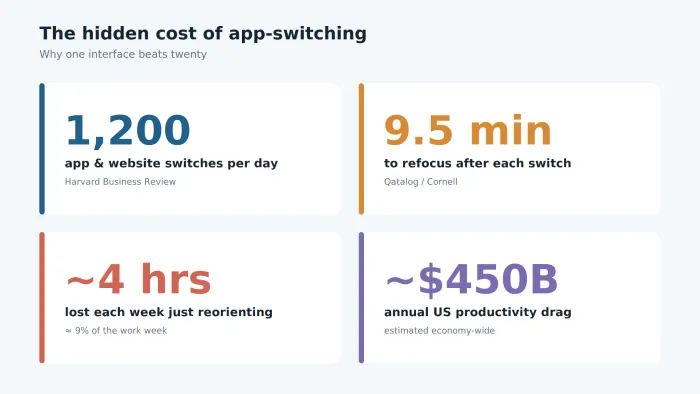
A study published in Harvard Business Review tracked employees at three large companies and found the average person toggles between apps and websites roughly 1,200 times a day. Asana’s research on knowledge work puts the number of distinct apps a person juggles at around nine. A 2025 tracking study of US consumers landed higher, at about 18 different apps opened per day. Whatever the exact figure for you, the shape is the same: a life sliced into dozens of small, separate windows.
Let me start with how we got here, because the pattern behind it is old.
The quiet history of getting closer to what I mean
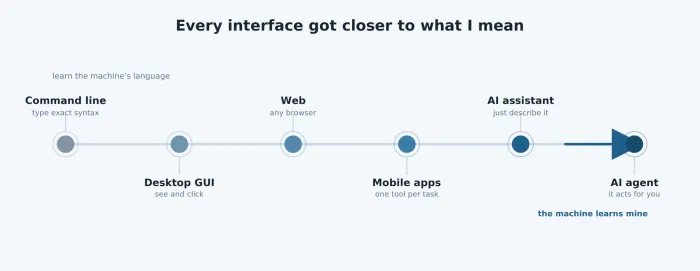
Every interface I have used in my life did one job. It narrowed the distance between what I meant and what the machine understood.
The command line asked me to memorize exact syntax, and one wrong character bought me nothing but an error. The graphical desktop swapped typed commands for things I could see and click, and overnight my parents could use a computer without a manual. The web lifted those windows off a single machine and onto any screen with a browser. Mobile apps then handed me a purpose-built tool for every task and dropped it in my pocket, which felt like pure progress right up to the moment I was carrying eighty of them.
Look at the direction across those decades. We keep moving from “learn the machine’s language” toward “the machine learns mine.”
The chat assistant is the next step on exactly that line, and the agent that acts for me is the step after. Typing plain language into one box and getting a result is not a break from computing history. It is the next rung on a ladder we have been climbing since the 1970s. I will come back to that word “agent” soon, because it carries most of the weight in this story.
The tax I pay for living in twenty apps
Before I reach the fix, I want to sit inside the problem, because the cost is heavier than it feels in the moment.
The constant toggling has a name. Psychologists call it context switching, and it is measurable. A joint study by Qatalog and Cornell found it takes about 9.5 minutes on average to get back into a productive flow after switching to a different application. Nine and a half minutes sounds trivial until you stack it against dozens of switches a day.
The waste compounds into something absurd.
Analysts who studied that 1,200-toggles-a-day figure estimated workers lose close to four hours a week, around 9% of the working day, doing nothing but reorienting after each jump. Widen the lens to a whole economy and researchers have put the drag of context switching on US productivity near $450 billion a year. That downtime is the cost of the reload screen between pieces of real work.
Here is the number that convinced me this shift is driven by people, not by companies with something to sell. Even though a typical person opens around 18 apps a day, six of them absorb nearly half of all screen time, according to RealityMine. We scatter ourselves across tools we barely use. And in a 2025 survey, 22% of people said they feel overwhelmed by how many apps sit on their device and are hunting for something more integrated.
That last figure is the whole argument in miniature. The demand for one place to get things done already exists. Something just has to fill it.
When I stopped clicking and started asking
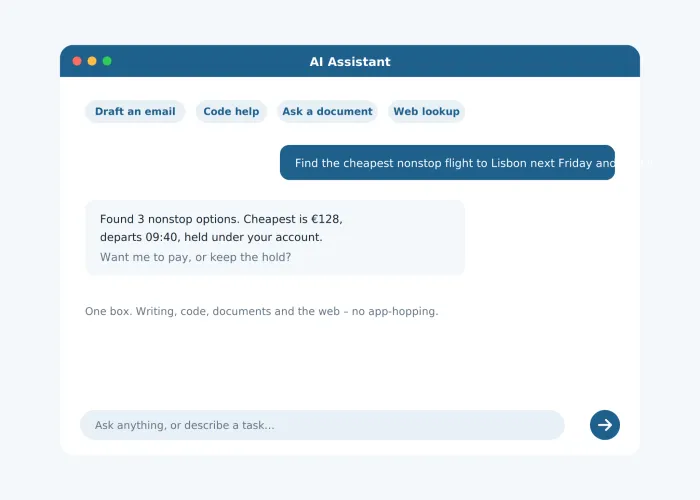
So what does “one place” look like when I put it to work?
Picture the old route to a booked flight. Open a browser. Run a search. Open three comparison sites. Filter for nonstop. Squint at fare classes I only half understand. Type in passenger details. Find a card. Pay. Seven steps across several tabs, ten minutes on a good day and a headache on a bad one.
Now the version I already lean on for smaller jobs. I type one sentence: “Find the cheapest nonstop flight to Lisbon next Friday and hold it.” The interface becomes a single point of contact. I stopped operating the tool and started stating the result I wanted.
This is why a plain text box is eating the icon grid. Rather than learning where every button hides across twenty different layouts, I describe the outcome and let the assistant locate the buttons. A growing share of my day now runs through single-window assistants like ChatGPT, Claude, Perplexity, or ReDeepSeek, where drafting an email, getting help with code, asking questions about a document, and running a quick web lookup all live behind the same prompt instead of four separate apps. The interface stopped being somewhere I navigate. It became somewhere I talk.
That handles information and light tasks well. The harder test is whether an assistant can go and do the multi-step things I dread, and that is where agents earn their name.
The flip: I stop using apps, and the AI starts
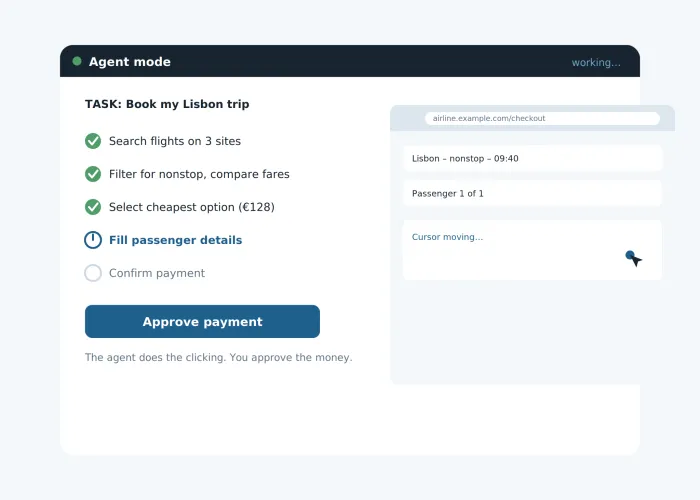
Here is the structural change at the center of everything, and it is simpler than it sounds.
The old model is Human uses App. I am the one clicking. The new model is Human tells AI, and AI uses Apps. The assistant does the clicking now.
Once that flip happens, an app stops being my destination and becomes infrastructure the AI reaches for on my behalf. This is not a whiteboard fantasy. In January 2025 OpenAI released Operator, an agent that drives its own web browser, filling out forms and assembling grocery orders by pointing and clicking the way a person does. By that summer it had been folded into ChatGPT as an agent mode. Anthropic had shipped its own Computer Use capability a little earlier, in late 2024.
I want to be straight about how well this works today, because honesty serves you better than a sales pitch. In its early months, Operator’s marquee tasks, booking a flight or finishing a checkout, succeeded under half the time on messy real-world sites cluttered with pop-ups and awkward payment flows. The direction is real and the pipes are being laid. The tireless agent that runs your whole life end to end, with no supervision, has not arrived.
Which raises the fair question: if agents still struggle to drive websites like a human, how does any of this get reliable? The industry’s answer is to stop making the AI imitate a human clicking, and to build it a cleaner door instead.
The plumbing nobody sees: how apps plug into the AI
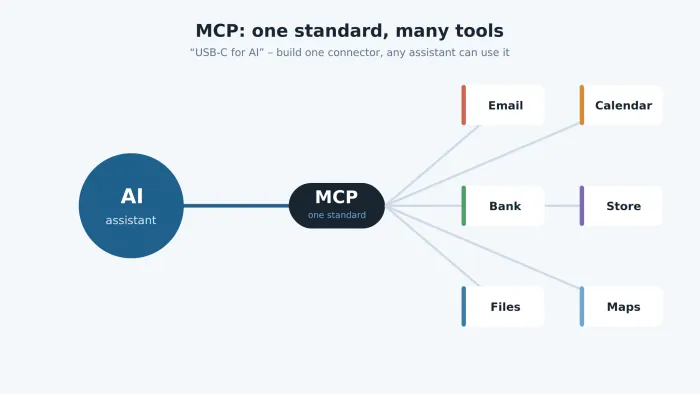
For an assistant to use my apps, it needs a standard way to connect to them. That sounds like the dullest sentence in this article. It describes the most important development in it.
In November 2024, Anthropic introduced the Model Context Protocol, usually shortened to MCP. The common description is “USB-C for AI,” and the comparison holds up. Before it, every connection between an AI and a tool was hand-built. Ten assistants wired to a hundred tools meant something close to a thousand one-off integrations. MCP replaces that mess with a single shared standard, so a tool exposes one connector and any compliant assistant can use it.
What happened next is the tell.
By March 2025, OpenAI, Anthropic’s chief rival, adopted MCP across its products. Google and Microsoft joined within months. By late 2025 there were more than 10,000 active public MCP servers and tens of millions of monthly downloads of the developer kits. Then in December 2025 Anthropic handed the protocol to a foundation under the Linux Foundation, backed by OpenAI, Google, Microsoft, and AWS, placing it in the same neutral category as the standards that quietly run the open internet.
Rivals do not adopt each other’s protocols for sport. They do it when a shared standard is already too useful to fight over. That cross-industry pile-up is the strongest evidence I have that apps sliding beneath an AI layer is a direction the whole field is building toward, and not a tidy metaphor I invented.
I promised earlier to explain why companies keep choosing assistants over shipping another app. MCP is what makes that choice practical.
Why the giants are betting on assistants, not more icons
Follow the money and the engineering, and the pattern is hard to miss.
OpenAI, Google, Microsoft, Anthropic, Amazon, and Apple are all sprinting toward assistants that complete tasks rather than storefronts that list more tools. The pieces they keep pouring resources into repeat across every company: models that reason through a problem, tool-calling so a model can trigger real actions, memory so it recalls my preferences, and the MCP connective tissue from the previous section. By early 2026, industry trackers estimated roughly 80% of Fortune 500 companies were running AI agents in some production workflow.
Search is the first visible casualty of this behavior change.
Gartner projected that traditional search engine volume would fall 25% by 2026 as people ask assistants instead of typing queries and scanning links. Bill Gates has pushed the idea further, suggesting that capable personal agents will mean people stop visiting search sites at all.
I will add the honest caveat, because balance matters. Not every analyst accepts the timeline. The clickstream firm Datos went looking for that decline in real traffic data and found no clear drop yet, with people sampling AI tools and then sliding back to Google out of pure habit. The direction of the shift is well supported. Its speed is openly contested, and I would distrust anyone who claims to know the exact year it tips.
Which industries feel it first
Some corners of daily life will hand their front door to an AI layer sooner than others. Here is where I expect the earliest change, and what the assistant quietly swallows in each case.
| Industry | What the AI layer absorbs |
|---|---|
| Customer support | Help-desk portals and ticket forms |
| Banking and personal finance | Several separate money and budgeting apps |
| Travel | Comparison and booking websites |
| Healthcare admin | Appointment and scheduling portals |
| Shopping | Product search and price hunting |
| Productivity | The scatter of separate office tools |
| HR and internal ops | Clunky internal software nobody enjoys |
The thread running through the table is simple. Anywhere I currently do tedious navigation to reach a plain outcome is a place an assistant can stand in front of. Which leads straight to the question I have been circling since the first paragraph.
So will apps actually disappear?
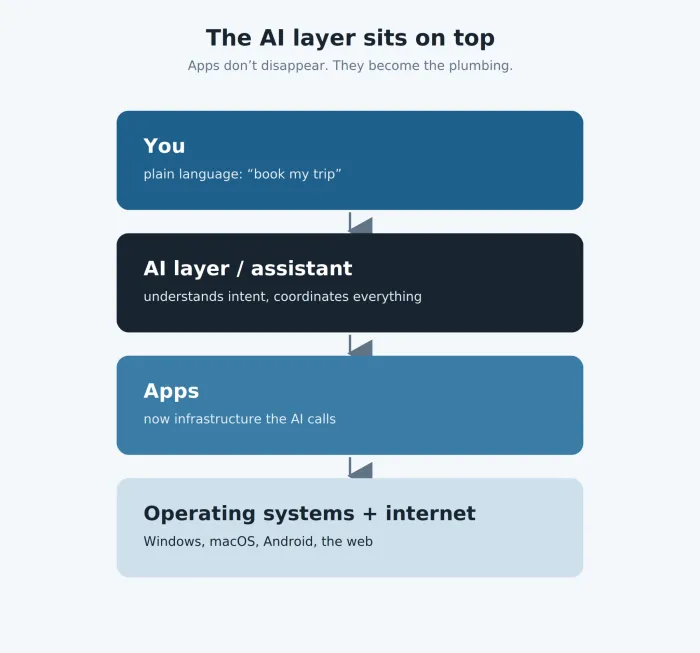
No. And working that out changed how I think about the whole shift.
The apps do not die. They go invisible.
Think about electricity for a second. I never think about which power plant or which grid operator sits behind the socket in my wall. I flip a switch and light happens. All that generation is still there, doing enormous work every second. It simply stopped being something I interact with directly.
Apps are heading for the same fate. The flight-booking engine still runs. The payment network still clears my card. The mapping database still calculates the route. I just stop opening each one, because the assistant reaches through them while I stay inside a single conversation. Sitting above all that software, an orchestration layer coordinates the pieces, which is why a growing number of people have started calling the AI layer a new kind of operating system, one that sits over Windows, macOS, Android, and the apps themselves.
I care whether the seat is booked and the bill is paid. I have stopped caring which icon did it. That indifference, multiplied across billions of people, is what turns apps from destinations into plumbing, and it is the clearest way I can justify the title of this piece.
Now the part I do not want to skip.
What is still broken
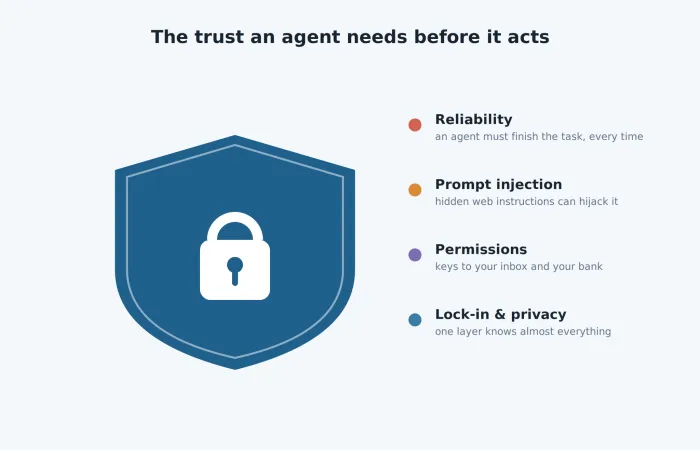
A fair view has to name the problems, and a few of them are serious.
Reliability comes first. An agent that finishes a checkout less than half the time is not something I will trust with my card while I look away. Hallucination makes it worse, because an assistant that confidently books the wrong date costs me more than no assistant at all.
Security is the sharper worry. Because MCP lets an AI reach into my tools, a poisoned instruction hidden inside a webpage can try to hijack it, an attack known as prompt injection. Security researchers flagged exactly these weaknesses through 2025, including a critical flaw in one of MCP’s own tools that had to be patched. Handing an agent the keys to my inbox and my bank raises the stakes on every bug it might contain.
Then comes the quieter danger of lock-in. If one assistant becomes the layer I run my entire life through, that single company gains extraordinary influence over what I see and what I buy. Privacy sits right beside it, because an assistant useful enough to act for me has to know an uncomfortable amount about me.
None of this is a reason to wave the shift away. It is the reason the shift will arrive in careful steps rather than one overnight leap, with a human signing off on the important moves for a good while yet.
What this means for me, and for anyone building
For me as a user, a skill that mattered for thirty years is quietly losing its value: knowing where every feature hides inside every app. The skill replacing it is describing what I want with precision. The person who can state intent clearly now gets more from these assistants than the person who has memorized the most keyboard shortcuts.
For anyone building software, the ground is moving faster.
If the AI is the front door, then a clean, well-documented API is your real storefront, and an MCP server is how an assistant finds you at all. Forrester expects a large share of enterprise software vendors to ship their own MCP servers across 2026 for precisely this reason. The interface you spent years polishing counts for a little less each quarter. The live question is whether an agent can reach your service, understand what it does, and act through it.
That reframes the entire competitive map. The businesses that expose their capabilities cleanly, so the AI layer can reach in and put them to work, become the ones assistants pick by default. The businesses that stay locked behind a walled-off app, betting I will keep tapping their icon out of habit, become the ones the assistant quietly routes around on its way to someone else.
The Bottom Line
I don't think the icon grid dies in 2026. I think it stops being where I start.
The shift is already load-bearing. Rivals who agree on nothing agreed on MCP. Agents can book a flight today. They do it clumsily, and they get a little better each quarter. Search is bleeding queries to assistants that answer in one turn. None of that is a forecast. It is this year's product roadmap.
So here is the practical read. If you use software, the habit worth building now is stating outcomes clearly instead of memorizing menus. If you build software, one blunt question decides your next three years: can an agent reach your service and act through it? Answer yes and the AI layer sends work your way. Answer no and it quietly books someone else.
The businesses still treating their app as the destination are polishing a front door that fewer people will walk through.