I once left the About field on a new profile blank for three weeks. Every time I opened it, I typed a sentence I hated and closed the tab. The trouble was not that I had nothing to say about my work. It was that I had to be a copywriter and an editor at once, on demand, inside a box the size of a text message.
Then I started using RedeepSeek, and the blank box stopped winning. This article collects the prompts I now paste in for different profiles and the formula that makes them work. I have added the real output a few of them produced, so you can see what lands before you write your own. Copy anything here and swap in your details.
The Bio Problem Nobody Warns You About
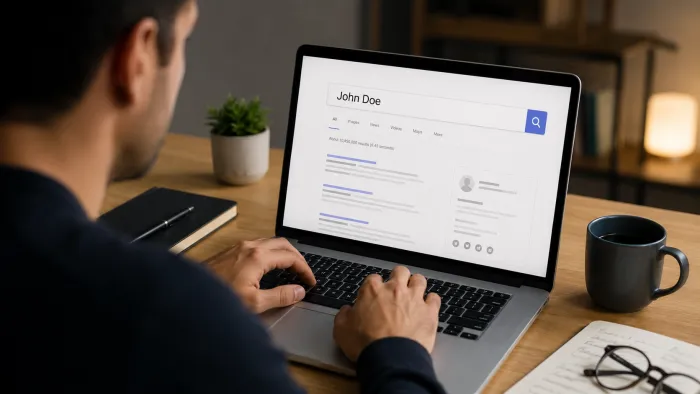
A bio is often the first thing a stranger reads about you.
Before they see your portfolio, before you get a chance to speak, a few sentences decide whether you are worth more attention. A recruiter skims it and moves on in seconds. A client reads it and quietly decides if you are worth an email.
Here is the part that made bios hard for me. The same facts about my career need to sound different depending on where they land. My LinkedIn summary and my Instagram bio describe the same person, yet one wants credibility and the other wants personality in the space of a phone notification.
Each platform rewards a different shape.
That is why a single master bio almost never works. Here is how the main platforms differ:
| Platform | What it rewards | Rough length |
|---|---|---|
| Credibility and results a recruiter can search for | 150 to 300 words | |
| Personality and one clear call to action | Under 150 characters | |
| X (Twitter) | Wit and a sharp sense of who you help | Under 160 characters |
| YouTube | What the channel is about and why to subscribe | 100 to 200 words |
| Portfolio site | A short story of your work and taste | 100 to 250 words |
Once you accept that you need a few bios instead of one, writing them all by hand becomes a chore. Closing that gap is the whole reason I reached for a tool, which brings me to the next section.
Why I Reach for RedeepSeek
RedeepSeek is an AI assistant that writes content, explains and debugs code, reads documents you upload, and answers questions using current information from the web. For bios, only the writing part matters, and it handles short pieces that have to hit a specific tone.
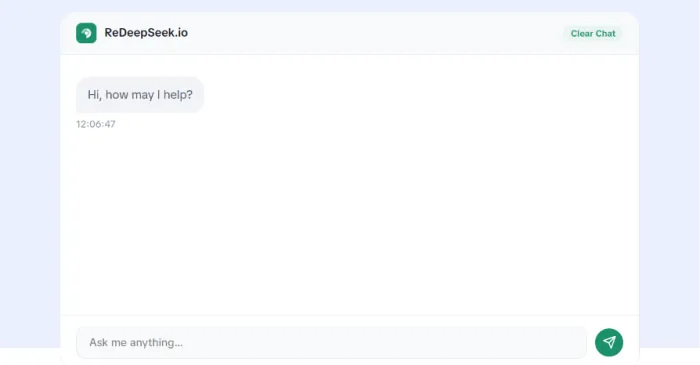
Four habits keep me coming back to it for this particular job.
- It gives me several versions from one request, so I can pick the phrasing that sounds most like me instead of settling for the first draft.
- It holds a tone. Ask for confident but warm, or dry and minimal, and the wording actually shifts.
- It respects a word or character count when I state one clearly, which matters on platforms that cut you off mid-sentence.
- It gets me past the blank box in seconds, so the hard part becomes editing instead of starting.
One honest caveat before we go further. The output is only as good as the request behind it, and I wrote plenty of forgettable bios before I understood what to include. The next section is the fix I wish I had found on day one.
The Anatomy of a Bio Prompt
When my bios were bad, the reason was almost always the same. I told RedeepSeek what I wanted, a bio, without telling it enough about me or the moment. A strong prompt answers a handful of questions before it asks for anything back.
| Ingredient | What to specify | Example |
|---|---|---|
| Role | Your job or title | Freelance UX designer |
| Experience | Years and industry | 8 years in fintech |
| Achievements | Numbers, awards, or named work | Redesigned an app used by 2M people |
| Audience | Who reads this bio | Hiring managers at startups |
| Tone | The feeling you want | Confident and plain-spoken |
| Platform | Where it goes | A LinkedIn summary |
| Length | Words or characters | Around 120 words |
Put those together and you get a formula worth memorizing:
Role + Experience + Achievements + Audience + Tone + Platform + Length
The difference this makes is not small. Here is the same request written two ways.
A vague prompt:
| Write a bio for me. I'm a designer. |
|---|
A detailed prompt:
| Write a 120-word LinkedIn summary for a freelance UX designer with 8 years in fintech who redesigned a banking app used by 2 million people. Audience: startup hiring managers. Tone: confident and plain-spoken. Write it in the first person. |
|---|
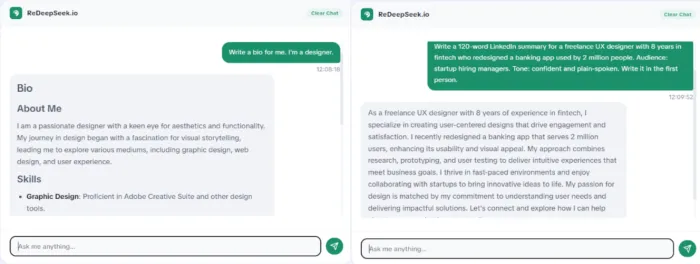
The first request produces a bio that could belong to anyone. The second produces something a hiring manager might remember, because every word had a job. Keep this formula close. Every prompt in the section below is built from it.
The Prompts I Actually Use
I keep these in a single note and paste them in whenever a profile needs filling. Replace the bracketed parts with your own details. I have grouped them by where you are most likely to need them, starting with the professional bios that tend to affect income.
Career and professional
1. The LinkedIn summary
Best for: your main professional profile.
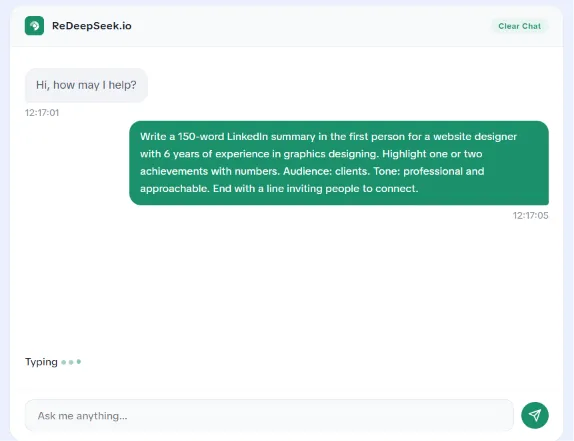
| Write a 150-word LinkedIn summary in the first person for a [job title] with [X years] of experience in [industry]. Highlight one or two achievements with numbers. Audience: [recruiters or clients]. Tone: professional and approachable. End with a line inviting people to connect. |
|---|
Why it works: it forces specifics and gives RedeepSeek a clear closing line, so you get a summary with a point instead of a pile of adjectives.
What RedeepSeek produced:
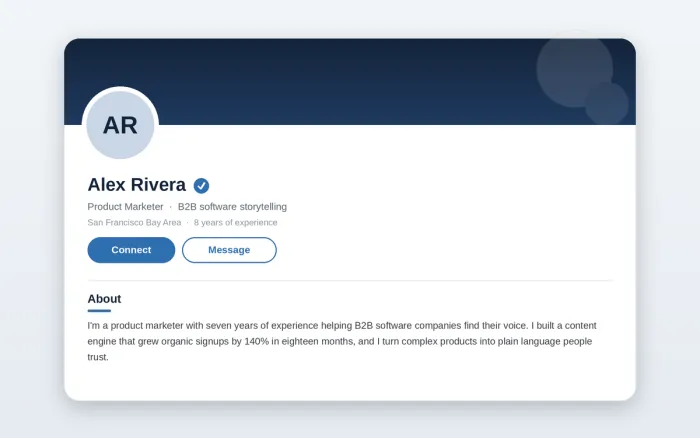
| I'm a product marketer with seven years of experience helping B2B software companies find their voice. At my last role I built a content engine that grew organic signups by 140% in eighteen months. I care about turning complicated products into plain language people trust, and I keep an eye on the numbers behind every campaign. If you are building something and need a marketer who thinks like an editor, let's talk. |
|---|
2. The resume summary
Best for: the top of a CV or resume.
| Write a short professional summary (2 sentences) for the top of a resume. Role: [title]. Standout strength: [skill]. Best result: [achievement with a number]. Keep it in the third person and skip buzzwords. |
|---|
Why it works: the two-sentence cap keeps it tight, and third person matches what resumes expect.
3. The executive bio
Best for: company leadership pages and conference programs.
| Write a 100-word third-person executive bio for a [title] at [company]. Include [years] of experience and one signature achievement. Mention one area of expertise. Tone: authoritative and calm. Suitable for a company leadership page. |
|---|
Why it works: leaders read as credible when the writing stays calm and specific, and 100 words is the sweet spot for a leadership page.
4. The startup founder bio
Best for: pitch decks and press kits.
| Write a 90-word founder bio in the third person for the founder of [company], a startup that [what it does] for [target customer]. Mention the founder's background in [field] and why they started the company. Tone: visionary but grounded. |
|---|
Why it works: investors and journalists want the reason a company exists, so naming the motivation gives the bio a backbone.
What RedeepSeek produced:
| Maria Chen is the founder of Loop, a scheduling platform built for independent clinics. Before Loop, she spent six years managing operations for a chain of physiotherapy practices, where she watched staff lose hours every week to double-booked calendars. She started Loop to give small clinics the kind of software that used to belong only to hospitals. She holds a background in health operations and a stubborn belief that good tools should be quiet and reliable. |
|---|
The next few are for people selling their own services, where the bio doubles as a quiet sales pitch.
Freelance and business
5. The freelancer bio
Best for: your portfolio site or a marketplace profile.
| Write a 100-word first-person bio for a freelance [role] who helps [type of client] achieve [outcome]. Include [years] of experience and one result with a number. Tone: warm and confident. End with a clear invitation to get in touch. |
|---|
Why it works: it centers the client's outcome, which is what turns a bio into a booking.
Tip: swap warm and confident for playful if your niche rewards personality over polish.
6. The small business owner bio
Best for: an About page or a local listing.
| Write a 120-word bio for the owner of [business name], a [type of business] serving [location or community]. Explain what makes the business different and why the owner cares about the work. Tone: friendly and trustworthy. Write in the first person. |
|---|
Why it works: local customers buy from people, so tying the business to a personal reason builds trust faster than a feature list.
Social bios play by stricter rules, because the character count is tight and the reader is already scrolling.
Social media
7. The Instagram bio
Best for: your Instagram profile.
| Write four short Instagram bios under 150 characters each for a [role or niche]. Give each a clear hook and one reason to follow. Suggest where an emoji or two could sit. Tone: [your vibe]. |
|---|
Why it works: the character cap and the structure give you something you can paste in without trimming.
What RedeepSeek produced:
Helping small brands sound human. Copywriter and brand strategy. 40+ launches booked this year. Free brand-voice guide in the link below. |
|---|
8. The X (Twitter) bio
Best for: your X profile.
| Write a bio under 160 characters for X for a [role] in [niche]. Say who I help and one thing that makes me credible. Keep it punchy. No hashtags. |
|---|
Why it works: the credibility line keeps the bio from sounding like everyone else in the niche.
9. The YouTube channel description
Best for: your channel's About tab.
| Write a 150-word YouTube channel description for a channel about [topic]. Explain what viewers will learn and how often I post. Give one clear reason to subscribe. Front-load the first two lines, since they show in search. |
|---|
Why it works: YouTube shows only the opening lines in previews, so front-loading them earns more clicks.
The last group covers creative and specialist bios, where a little voice earns a lot of goodwill.
Creative and specialist
10. The author or writer bio
Best for: book jackets and guest-post credits.
| Write a 60-word third-person author bio for a writer of [genre]. Mention one publication or book and one personal detail that makes me human. Tone: literary but not stuffy. |
|---|
Why it works: the personal detail is the part readers remember, and the word cap stops it wandering.
11. The developer or technical bio
Best for: GitHub profiles and conference talk pages.
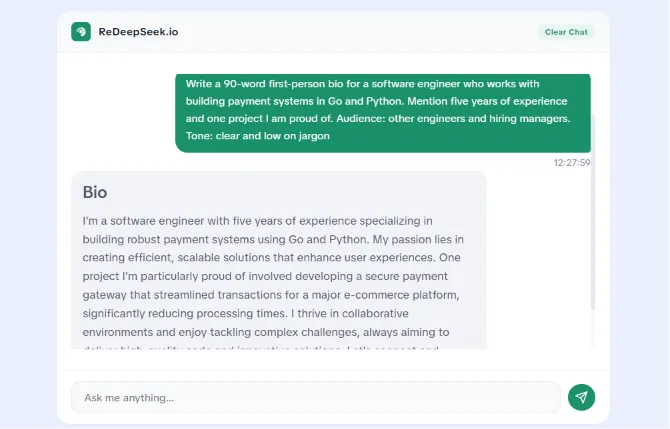
| Write a 90-word first-person bio for a software engineer who works with [languages or stack]. Mention [years] of experience and one project I am proud of. Audience: other engineers and hiring managers. Tone: clear and low on jargon. |
|---|
Why it works: engineers trust plain language, and naming a real project beats listing every technology you have touched.
What RedeepSeek produced:
| I'm a software engineer with five years of experience specializing in building robust payment systems using Go and Python. My passion lies in creating efficient, scalable solutions that enhance user experiences. One project I'm particularly proud of involved developing a secure payment gateway that streamlined transactions for a major e-commerce platform, significantly reducing processing times. I thrive in collaborative environments and enjoy tackling complex challenges, always aiming to deliver high-quality code and innovative solutions. Let's connect and explore how I can contribute to your team! |
|---|
Making the Bio Sound Like You
RedeepSeek hands you a strong draft. It cannot hand you your specifics, and that is where most people stop too soon. Here is what I do to every generated bio before it goes live.
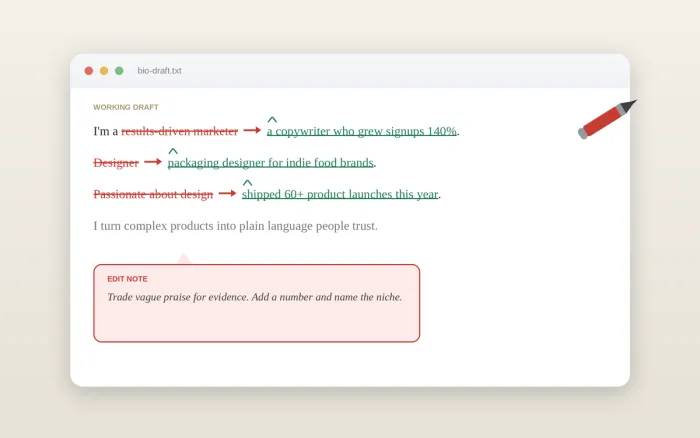
- Trade vague praise for evidence. "Experienced marketer" means nothing; "grew a newsletter from 0 to 30,000 readers" means something. Numbers do the convincing for you.
- Name your niche. "Designer" is a category; "packaging designer for indie food brands" is a person someone wants to hire.
- Match the tone to the destination, using the platform table from earlier as a guide. The voice that works on your portfolio will feel stiff on Instagram.
- Read it out loud. If you stumble, a reader will too. This one edit catches more awkward phrasing than any spell-check.
I also keep a rule about freshness. A bio that still lists a job you left two years ago quietly tells people you are not paying attention, so I re-run the matching prompt whenever something real changes.
Mistakes That Cost Me Good Bios
I made all of these at least once, so treat this as the shortcut past my worst drafts.
- Asking with a vague prompt. "Write me a bio" gives you a bio for no one. The formula from earlier exists to prevent exactly this.
- Forgetting the audience. A bio aimed at recruiters reads differently from one aimed at customers, and RedeepSeek can only account for that if you say who is reading.
- Ignoring the character limit. I once pasted a lovely Instagram bio that got chopped mid-word because I never told the tool about the cap.
- Reusing one bio everywhere. The LinkedIn summary that lands you an interview looks out of place under a tweet, as covered in the platform differences above.
- Publishing the raw output. AI drafts have tells, and a quick edit to add your voice is the difference between sounding like a template and sounding like you.
Avoid these and you are already ahead of most profiles I read.
Steal These Templates
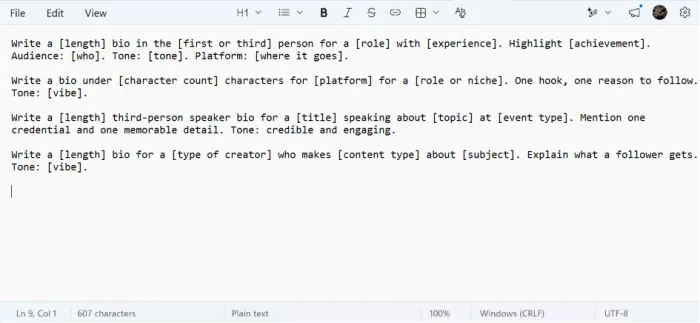
If you would rather start from a skeleton than a category, here are fill-in-the-blank versions that pack the formula into ready shapes. Paste one into RedeepSeek and replace the brackets.
Universal bio
| Write a [length] bio in the [first or third] person for a [role] with [experience]. Highlight [achievement]. Audience: [who]. Tone: [tone]. Platform: [where it goes]. |
Short social bio
| Write a bio under [character count] characters for [platform] for a [role or niche]. One hook, one reason to follow. Tone: [vibe]. |
Speaker bio
| Write a [length] third-person speaker bio for a [title] speaking about [topic] at [event type]. Mention one credential and one memorable detail. Tone: credible and engaging. |
Creator bio
| Write a [length] bio for a [type of creator] who makes [content type] about [subject]. Explain what a follower gets. Tone: [vibe]. |
Keep the ones you use in a note like I do, so the next blank box takes thirty seconds instead of three weeks.
Where to Start
Pick the one profile that earns you the most attention right now, maybe the LinkedIn summary a recruiter reads or the portfolio bio a client lands on. Run its prompt from the list above, then edit for ten minutes before you publish. You will learn more from watching how a sharper bio changes who reaches out than from polishing a generic one for another week.